
Back to Eximietas Software

Digital & Intelligence Engineering · Modern platforms

Software Product Modernization

Modern software foundations that make products easier to evolve, scale, and operate.

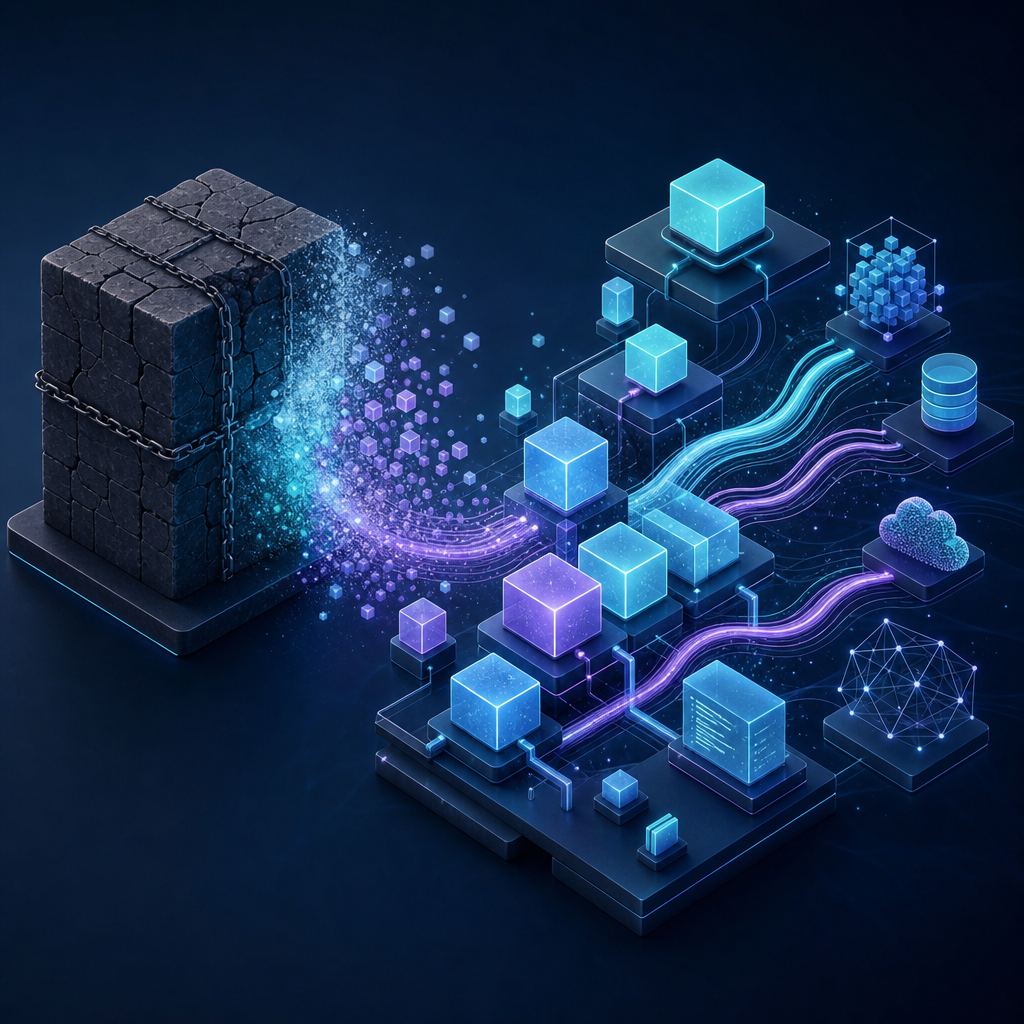
Legacy software architecture transforming into modular services, APIs, and a modern product platform
Modern product foundations

The work

Engineering that holds up beyond the demo.

We help teams modernize products without losing the domain knowledge embedded in them. Architecture, delivery, and user experience move forward together so modernization creates momentum instead of disruption.

What we help you achieve

  • A clearer path away from fragile legacy dependencies
  • More adaptable architecture and safer change
  • Faster delivery with better release confidence
  • Improved security, performance, and operational visibility
  • Modern capabilities without a disruptive rewrite

Detailed capabilities

The work behind a dependable platform.

Explore the engineering areas that take this capability from a first technical decision to a stable, production-ready system.

01

Product & Legacy System Assessment

Modernization begins with evidence about what the system does, where risk lives, and what cannot be interrupted.

  • Map domains, users, business capabilities, applications, integrations, data flows, environments, and ownership
  • Assess code health, dependencies, architecture, performance, security, operability, testability, and release friction
  • Identify hidden business rules, coupling, critical paths, unsupported components, and migration constraints
  • Prioritize modernization slices by customer value, risk reduction, technical feasibility, and continuity requirements
02

Risk-Managed Modernization Roadmap

A staged path protects the business while creating visible progress and feedback.

  • Choose strangler, modularization, re-platform, rehost, refactor, replace, or targeted rewrite patterns per capability
  • Define seams, anti-corruption layers, API contracts, data synchronization, coexistence, and cutover strategies
  • Plan increments with measurable outcomes, rollback points, parallel run, feature flags, and decommission criteria
  • Align architecture changes with product roadmap, compliance, release windows, team capability, and budget
03

Architecture, API & Data Evolution

Modern software needs boundaries that let the product change without spreading legacy assumptions everywhere.

  • Refactor modules and domains, introduce stable APIs, events, contracts, adapters, and ownership boundaries
  • Modernize relational, document, file, cache, and event data paths with migration, reconciliation, and integrity checks
  • Separate presentation, application, domain, integration, and infrastructure concerns where it reduces change risk
  • Prepare data and service interfaces for analytics, automation, AI retrieval, and new customer experiences
04

Delivery, Quality & Platform Uplift

Modernization must improve how software is built and operated, not only how it is structured.

  • Introduce automated builds, tests, security checks, infrastructure changes, deployment, feature flags, and release evidence
  • Establish unit, contract, integration, end-to-end, performance, migration, and regression coverage around each slice
  • Improve logs, metrics, traces, alerts, SLOs, runbooks, incident response, and service ownership
  • Containerize or re-platform workloads where useful, with environment parity, repeatable configuration, and cost visibility
05

User Experience & Continuous Transformation

The customer should feel the product becoming easier and more capable while the underlying change remains controlled.

  • Modernize workflows, information architecture, accessibility, responsiveness, and interaction patterns alongside backend slices
  • Use telemetry, user research, support signals, and product analytics to prioritize improvements
  • Retire redundant paths and infrastructure deliberately with data archival, contract communication, and rollback options
  • Leave teams with architecture principles, decision records, engineering standards, and a roadmap for the next increments

Technical scope

Engineering detail from reset to runtime.

The work is designed around observable system behavior: what executes first, how resources are controlled, how failures are recovered, and how the platform proves it is ready.

01

Assessment & roadmap

  • Domain, application, dependency, data-flow, integration, environment, ownership, security, performance, and operability mapping
  • Business-rule discovery, code health, coupling, unsupported components, release friction, and continuity constraints
  • Modernization pattern selection, value/risk sequencing, migration slices, cutover, rollback, and decommission criteria
02

Architecture & integration

  • Modularization, strangler patterns, re-platforming, re-architecture, adapters, anti-corruption layers, and bounded domains
  • API, event, contract, service, cache, queue, file, and third-party integration evolution
  • Data migration, synchronization, reconciliation, integrity checks, coexistence, and AI-ready retrieval or analytics interfaces
03

Delivery & reliability

  • CI/CD, feature flags, infrastructure automation, environment parity, release evidence, and rollback
  • Unit, contract, integration, end-to-end, performance, migration, security, and regression testing
  • Logs, metrics, traces, SLOs, alerting, runbooks, incident response, service ownership, and cost visibility
04

Product evolution

  • Workflow, information architecture, accessibility, responsiveness, and experience modernization
  • Telemetry, user research, support signals, product analytics, adoption, and value measurement
  • Team standards, architecture decisions, documentation, training, transition, retirement, and next-step roadmap

Services and customer value

Technical work with a business reason.

Every engineering activity is tied to a decision your team needs to make: bring up faster, reduce risk, improve determinism, or prove production readiness.

01

Legacy product assessment

Technical work

Map domains, dependencies, business rules, data flows, interfaces, code health, operations, security, and release constraints into an evidence-based modernization baseline.

Customer benefit

Leaders can make sequencing and investment decisions with a shared view of risk instead of relying on tribal knowledge.

02

Incremental architecture modernization

Technical work

Apply strangler, modularization, re-platforming, refactor, or targeted rewrite patterns with seams, adapters, coexistence, feature flags, and rollback.

Customer benefit

The product gains modern capabilities without betting the business on a single disruptive rewrite.

03

API, data, and integration evolution

Technical work

Introduce stable contracts, events, domain boundaries, data migration and reconciliation, integration adapters, and interfaces ready for analytics or AI.

Customer benefit

Teams can connect new experiences and systems without spreading legacy assumptions into every future change.

04

Cloud and delivery modernization

Technical work

Improve environments, containerization, CI/CD, testing, infrastructure automation, observability, security, SLOs, and release controls.

Customer benefit

Software ships more predictably and operates with less manual effort, lower risk, and clearer ownership.

05

Product experience modernization

Technical work

Modernize workflows, accessibility, responsiveness, information architecture, telemetry, and user feedback alongside the technical slices.

Customer benefit

Customers experience visible improvement while the organization preserves the domain knowledge that makes the product valuable.

Why this matters for AI

Intelligence needs a dependable execution layer.

AI features amplify the strengths and weaknesses of the product foundation beneath them. Modernizing domains, APIs, data quality, delivery controls, observability, and security creates the reliable interfaces and operating context that let AI be integrated into the product instead of bolted onto a fragile legacy core.

What you take forward

Clear outputs your team can build on.

  • Current-state assessment with domain map, dependency graph, data flows, risk register, code and platform findings, and continuity constraints
  • Modernization roadmap with prioritized slices, target architecture, chosen patterns, milestones, investment assumptions, and rollback/cutover plan
  • Incremental architecture package with modules, APIs, events, adapters, anti-corruption layers, data contracts, and coexistence controls
  • Migration and delivery package with data reconciliation, CI/CD, test strategy, feature flags, infrastructure automation, and release evidence
  • Operational and experience uplift with observability, SLOs, security controls, runbooks, UX improvements, telemetry, and adoption measures
  • Handoff with architecture decisions, engineering standards, ownership map, training, decommission plan, and next-wave backlog

Capability map

Built across the layers.

The right answer is usually a connected system of decisions, not a single isolated skill.

01

Application, architecture, dependency, and domain assessment

02

Strangler, modularization, re-platforming, and re-architecture

03

API, event, data, and integration modernization

04

Cloud migration, containerization, and platform engineering

05

CI/CD, testing, observability, security, and reliability uplift

06

UX modernization and AI-readiness planning

Keep exploring

See how the pieces connect.