
Back to Eximietas Software

Systems Engineering · Product experience

Multimedia & Display Pipelines

High-performance media and display paths engineered for responsive product experiences.

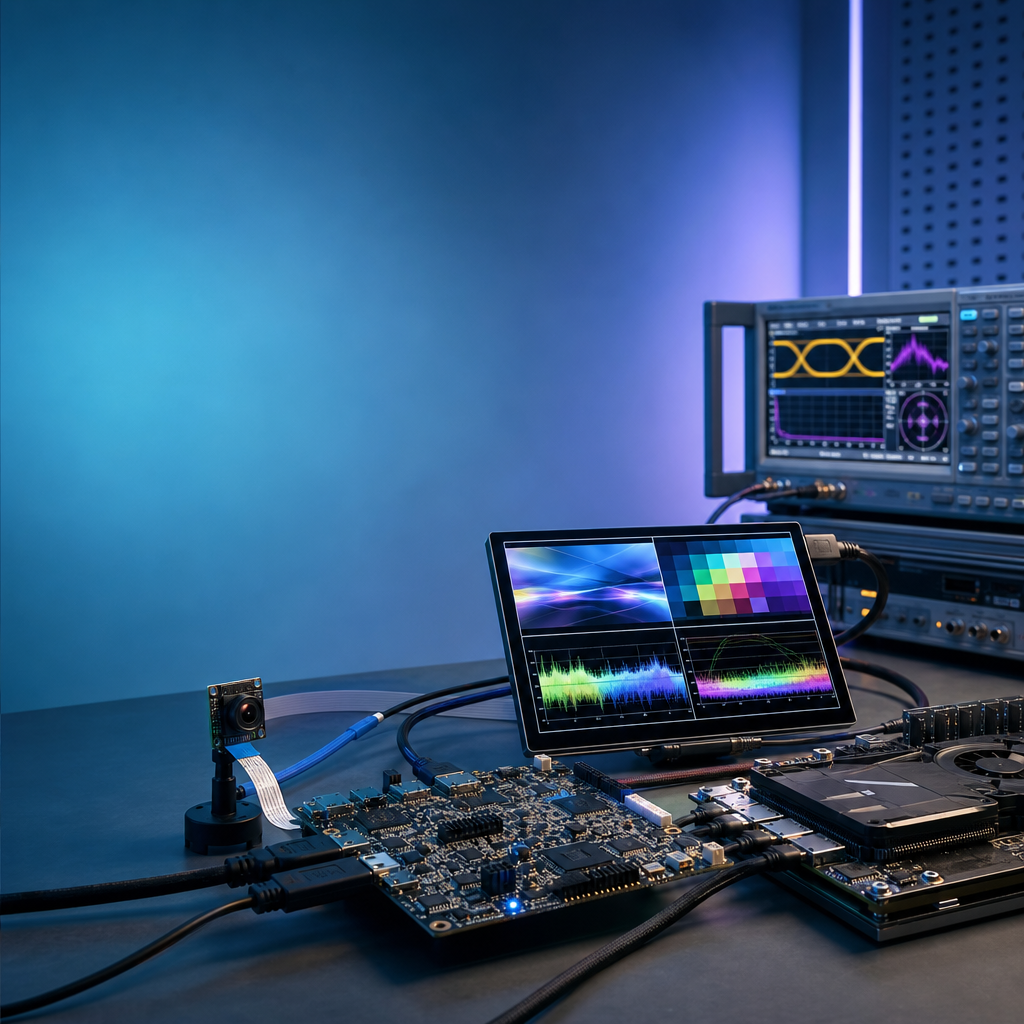
Embedded multimedia development board connected to a camera, display panel, GPU accelerator, and video test equipment
Media pipeline & display performance validation

The work

Engineering that holds up beyond the demo.

We engineer the complete media path behind rich displays and multimedia products: capture, processing, composition, encoding, decoding, audio, synchronization, and presentation. By aligning drivers, memory movement, hardware accelerators, and application behavior, we help teams deliver fluid experiences with measurable latency, predictable frame timing, and a platform ready for product differentiation.

What we help you achieve

  • Smooth visual performance
  • Lower latency across the media path
  • Predictable frame timing and synchronization
  • Efficient use of memory, bandwidth, and accelerators
  • A platform ready for product differentiation

Detailed capabilities

The work behind a dependable platform.

Explore the engineering areas that take this capability from a first technical decision to a stable, production-ready system.

01

Display Architecture & Composition

Display paths designed around the panel, GPU, compositor, operating system, and user-experience targets.

  • DRM/KMS, display controller, GPU, Wayland/Weston, Qt, Android SurfaceFlinger, and product compositor integration
  • Plane, overlay, framebuffer, scaling, rotation, color-space, pixel-format, and multi-display configuration
  • MIPI DSI, eDP, HDMI, DisplayPort, LVDS, and panel bring-up with timing, EDID, hotplug, and link-state handling
  • HDR, wide color gamut, variable refresh, backlight, adaptive brightness, touch coordination, and display power states
  • Tear-free presentation with explicit synchronization, frame pacing, vblank behavior, and missed-frame diagnostics
02

Camera Capture & Image Pipelines

Capture and image-processing paths that preserve frame integrity from sensor to application or inference workload.

  • MIPI CSI-2, parallel camera, USB video, V4L2, media-controller graphs, sensor controls, and ISP integration
  • Sensor modes, exposure, gain, frame rate, cropping, binning, synchronization, metadata, and calibration
  • Format negotiation, stride, alignment, buffer ownership, DMA-BUF, zero-copy paths, and multi-camera routing
  • Image signal processing, color conversion, scaling, denoise, HDR, lens correction, and application-facing APIs
  • Capture latency, dropped-frame analysis, timestamp integrity, trigger alignment, and camera-to-display or camera-to-AI handoff
03

Audio, Codec & Streaming Subsystems

Media services that keep audio and video efficient, synchronized, and resilient across local and networked playback.

  • ALSA/ASoC, audio codecs, I2S/TDM, HDMI/DisplayPort audio, microphone capture, routing, mixing, and device policy
  • H.264, H.265/HEVC, AV1, VP9, JPEG, raw video, hardware decode/encode, and accelerator runtime integration
  • GStreamer, FFmpeg, Android media frameworks, pipeline negotiation, plugin integration, and application contracts
  • A/V clocking, lip-sync, timestamp propagation, buffering, jitter handling, underrun/overrun recovery, and rate matching
  • Local playback, camera streaming, adaptive quality, network recovery, secure media paths, and resource-aware concurrency
04

Memory, DMA & Accelerator Paths

Data movement engineered to avoid unnecessary copies and keep CPU, GPU, ISP, codec, and NPU resources productive.

  • DMA-BUF, IOMMU, cache coherency, contiguous and scatter-gather memory, buffer queues, fences, and ownership transitions
  • Zero-copy capture-to-process-to-display or capture-to-inference pipelines with explicit synchronization
  • Bandwidth budgets across DDR, interconnects, GPU, ISP, codec, NPU, display controller, and storage
  • Pool sizing, buffer lifetime, backpressure, queue depth, cache behavior, and memory-pressure analysis
  • Cross-layer profiling to identify copy overhead, accelerator starvation, contention, thermal throttling, and pipeline bubbles
05

Latency, Power & Production Validation

Measured media behavior that remains stable across resolution, refresh rate, workload, thermal, and power constraints.

  • End-to-end latency budgets from sensor or input to display, audio, encode, network, and user-visible response
  • Frame pacing, jitter, dropped frames, underruns, stalls, A/V drift, startup time, seek behavior, and recovery testing
  • Performance and power tuning across CPU/GPU/ISP/codec/NPU frequency, thermal zones, suspend/resume, and multi-stream workloads
  • Stress, soak, resolution-switch, hotplug, suspend/resume, low-memory, degraded-network, and long-run media validation
  • Traceable measurements using ftrace, perf, platform counters, GPU/codec telemetry, frame probes, audio analyzers, and hardware-in-the-loop rigs

Technical scope

Engineering detail from reset to runtime.

The work is designed around observable system behavior: what executes first, how resources are controlled, how failures are recovered, and how the platform proves it is ready.

01

Display & presentation

  • DRM/KMS, GPU, Wayland/Weston, Qt, Android composition, planes, overlays, scaling, rotation, HDR, color, vblank, and frame pacing
  • MIPI DSI, eDP, HDMI, DisplayPort, LVDS, EDID, hotplug, panel timing, backlight, touch coordination, and multi-display behavior
  • Explicit synchronization, fences, refresh-rate policy, tear-free presentation, and display power states
02

Capture, audio & codecs

  • MIPI CSI-2, V4L2, media-controller graphs, ISP, sensor modes, calibration, metadata, ALSA/ASoC, I2S/TDM, and audio routing
  • H.264, H.265/HEVC, AV1, VP9, JPEG, raw video, hardware encode/decode, GStreamer, FFmpeg, and Android media frameworks
  • A/V clocking, timestamp propagation, buffering, jitter, lip-sync, underrun/overrun recovery, and adaptive streaming behavior
03

Memory & acceleration

  • DMA-BUF, IOMMU, cache coherency, buffer queues, fences, zero-copy paths, contiguous/scatter-gather memory, and ownership transitions
  • CPU, GPU, ISP, codec, NPU, display-controller, DDR, interconnect, and storage bandwidth budgets
  • Pool sizing, backpressure, queue depth, memory pressure, accelerator utilization, contention, and pipeline-bubble analysis
04

Performance & validation

  • End-to-end latency, frame timing, jitter, drops, stalls, startup, seek, resolution switching, hotplug, and recovery measurements
  • Power, thermal, frequency, suspend/resume, multi-stream, long-run, low-memory, and degraded-network characterization
  • ftrace, perf, platform counters, GPU/codec telemetry, frame probes, audio analysis, hardware-in-the-loop, and release evidence

Services and customer value

Technical work with a business reason.

Every engineering activity is tied to a decision your team needs to make: bring up faster, reduce risk, improve determinism, or prove production readiness.

01

Display and compositor integration

Technical work

Bring up display controllers, panels, GPU/compositor paths, DRM/KMS, Wayland or Android composition, multi-display behavior, color, scaling, refresh, and power states.

Customer benefit

A responsive, tear-free visual experience with fewer panel-specific surprises and clear evidence for product-level display requirements.

02

Camera and image pipeline engineering

Technical work

Integrate sensors, CSI-2, V4L2/media graphs, ISP controls, calibration, format negotiation, DMA-BUF, multi-camera routing, and capture-to-display or capture-to-AI flows.

Customer benefit

More reliable capture and higher-quality image data with predictable latency, fewer dropped frames, and a path to advanced camera features.

03

Audio, codec, and media framework integration

Technical work

Implement ALSA/ASoC and audio routing, integrate hardware codecs, and build GStreamer, FFmpeg, or Android media pipelines with timestamp, buffering, and recovery behavior.

Customer benefit

Stable playback, recording, streaming, and A/V synchronization across devices and workloads without costly application-layer workarounds.

04

Zero-copy and accelerator optimization

Technical work

Profile buffer ownership, DMA, cache, IOMMU, memory bandwidth, CPU/GPU/ISP/codec/NPU utilization, queue depth, and cross-layer pipeline contention.

Customer benefit

Lower latency and power consumption, better throughput, and more headroom for higher resolutions, additional streams, or AI workloads.

05

Media performance and power tuning

Technical work

Set measurable budgets for frame timing, startup, input-to-display latency, audio drift, thermal behavior, frequency policy, suspend/resume, and multi-stream operation.

Customer benefit

A smoother product experience that remains responsive under real operating conditions rather than only in a controlled demo.

06

Validation and production readiness

Technical work

Create frame, audio, codec, hotplug, resolution-switch, low-memory, long-run, degraded-network, hardware-in-the-loop, and regression coverage with traceable evidence.

Customer benefit

Earlier discovery of media failures, faster root-cause analysis, and stronger confidence that the platform is ready for release and field support.

Why this matters for AI

Intelligence needs a dependable execution layer.

Modern media products increasingly connect cameras, microphones, displays, and AI accelerators in one real-time path. Reliable timestamps, zero-copy buffers, predictable memory bandwidth, hardware codec integration, and thermal-aware scheduling determine whether models receive fresh data and whether results can be presented in time. We engineer the media foundation so computer vision, speech, multimodal, and generative experiences can run with measurable latency and production-grade recovery behavior.

What you take forward

Clear outputs your team can build on.

  • Media architecture, pipeline diagrams, subsystem ownership map, performance budgets, and hardware/software dependency register
  • Display, camera, audio, codec, compositor, driver, and accelerator integration with application-facing interface documentation
  • Buffer, DMA, synchronization, memory-bandwidth, queueing, and zero-copy design with implementation guidance
  • Latency, frame-pacing, A/V sync, throughput, power, thermal, and multi-stream measurements with optimization recommendations
  • Validation matrix, hardware-in-the-loop coverage, stress and soak results, failure reproduction paths, and release acceptance criteria
  • Production handoff package covering configuration, diagnostics, trace collection, known limitations, regression gates, and maintenance strategy

Capability map

Built across the layers.

The right answer is usually a connected system of decisions, not a single isolated skill.

01

Display and composition pipeline integration

02

Camera capture, ISP, and image-processing paths

03

Audio, codec, and streaming subsystem bring-up

04

Zero-copy buffers, DMA, and memory-bandwidth optimization

05

Frame timing, A/V synchronization, and latency tuning

06

Power, thermal, and multi-display optimization

07

Performance characterization and media validation

Keep exploring

See how the pieces connect.