Back to Eximietas Software

Digital & Intelligence Engineering · Operational AI infrastructure

LLM Ops and MLOps Pipelines & Deployment

The pipelines, evaluation, and deployment discipline that make models dependable.

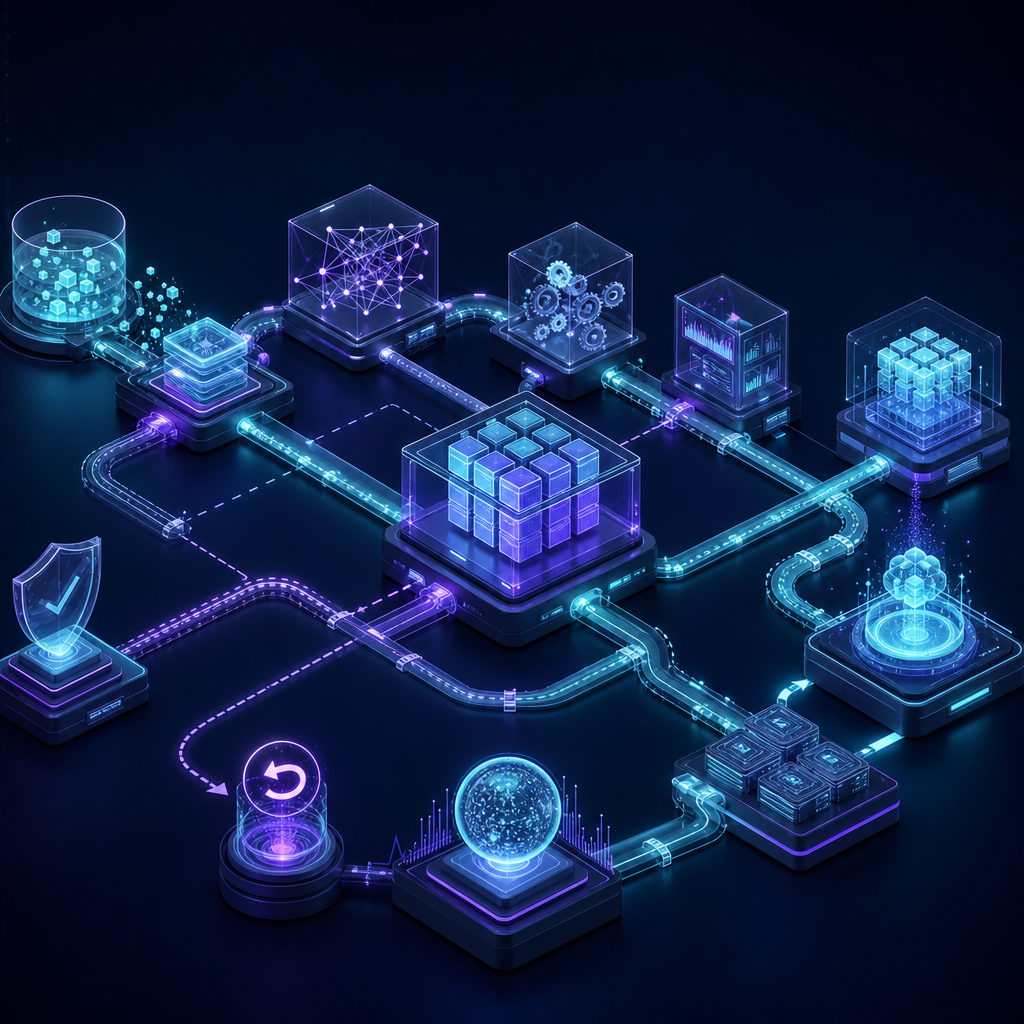
Automated LLMOps and MLOps pipeline connecting data, evaluation, deployment, monitoring, and rollback
Model lifecycle automation

The work

Engineering that holds up beyond the demo.

We build the operational backbone that moves LLM and ML systems from experiments into dependable products. Data, code, prompts, models, retrieval indexes, environments, and evaluation results are versioned together; automated CI/CD/CT pipelines promote only qualified assets into scalable serving environments with monitoring, governance, and clear rollback paths.

What we help you achieve

  • Repeatable model and prompt releases
  • Reproducible experiments with complete data and artifact lineage
  • Scalable serving with visible latency, quality, and cost
  • Earlier detection of drift, regressions, and unsafe behavior
  • Less friction between data science, engineering, security, and operations

Detailed capabilities

The work behind a dependable platform.

Explore the engineering areas that take this capability from a first technical decision to a stable, production-ready system.

01

Data, Experimentation & Reproducibility

The foundation of trustworthy operations is knowing exactly which data, code, configuration, and artifacts produced a result.

  • Dataset ingestion, validation, profiling, schema checks, quality thresholds, lineage, access controls, and versioned data contracts
  • Experiment tracking for code, parameters, features, prompts, models, dependencies, hardware, environment, metrics, and outputs
  • Reproducible training and evaluation with immutable artifacts, deterministic configuration, run metadata, and approval history
  • Feature engineering, feature stores, label management, train/test separation, leakage prevention, and dataset refresh workflows
  • Artifact registries and promotion rules for models, prompts, retrieval indexes, containers, evaluation sets, and deployment packages
02

CI/CD/CT Pipelines & Orchestration

Automated paths from commit and data change to validated model release, with continuous training treated as a first-class delivery concern.

  • CI pipelines for code, data transformations, feature logic, prompt templates, model packages, tests, security scans, and infrastructure
  • CD promotion across development, staging, canary, and production environments with approvals, quality thresholds, and rollback
  • Continuous training triggers based on schedules, new data, drift, performance degradation, incidents, or approved business events
  • Airflow, Kubeflow, Docker, Kubernetes, and cloud-native workflow orchestration with dependencies, retries, scheduling, and resource policies
  • Parallel evaluation, artifact promotion, environment manifests, reproducible build metadata, and release evidence for every deployment
03

LLMOps: Prompts, RAG & Fine-Tuning

Operational controls for the unique behavior, cost, knowledge freshness, and safety challenges of language-model systems.

  • Prompt, system-instruction, template, tool-schema, conversation-policy, and structured-output versioning with regression comparisons
  • RAG ingestion, embedding, indexing, retrieval, reranking, citation, freshness, access-control, and knowledge-quality pipelines
  • Model routing across foundation, open, hosted, small, and specialized models based on quality, privacy, latency, availability, and cost
  • Fine-tuning and adapter workflows with dataset curation, training configuration, evaluation, compatibility testing, and promotion gates
  • Guardrails for hallucination, unsupported claims, prompt injection, sensitive data, toxic content, unsafe actions, and human escalation
04

Scalable Serving & Cost Optimization

Serving architectures designed for the traffic pattern, latency target, data boundary, and unit economics of the product.

  • Real-time APIs, asynchronous jobs, batch inference, streaming responses, event-driven serving, and edge or hybrid execution
  • Containerized deployment with Kubernetes scheduling, autoscaling, health checks, rollout strategies, resource limits, and isolation
  • Model loading, warm pools, batching, quantization, distillation, caching, token budgets, concurrency, and accelerator utilization
  • Model routing, semantic caching, request prioritization, rate limits, quotas, fallback, and graceful degradation
  • Cost and performance measurement by model, tenant, workflow, token, request, device, environment, and business outcome
05

Monitoring, Drift & AI Observability

Production monitoring that sees changes in data, model quality, system performance, cost, and user outcomes before they become incidents.

  • Service health, latency, throughput, availability, queue depth, error rate, resource use, GPU utilization, and dependency monitoring
  • Data drift, feature drift, concept drift, label delay, out-of-distribution inputs, retrieval quality, and embedding-space changes
  • Model and LLM quality signals for accuracy, calibration, confidence, groundedness, relevance, toxicity, hallucination, refusal, and user feedback
  • Trace correlation across data pipelines, retrieval, prompts, tools, model calls, applications, infrastructure, and downstream actions
  • Alert thresholds, incident playbooks, automated rollback, retraining triggers, shadow evaluation, canaries, and post-incident learning
06

Governance, Security & Release Operations

Operational safeguards that make AI assets auditable, compliant, and manageable across their full lifecycle.

  • Model, dataset, prompt, retrieval, container, environment, dependency, and deployment lineage with immutable release records
  • Role-based access, tenant isolation, encryption, secrets handling, PII masking, retention, data residency, and network controls
  • Bias, safety, privacy, security, adversarial, prompt-injection, supply-chain, and policy checks integrated into delivery gates
  • Human approval, exception handling, risk acceptance, audit trails, evidence retention, incident ownership, and change management
  • Rollback, retirement, deprecation, model replacement, endpoint shutdown, data deletion, and disaster-recovery procedures

Technical scope

Engineering detail from reset to runtime.

The work is designed around observable system behavior: what executes first, how resources are controlled, how failures are recovered, and how the platform proves it is ready.

01

Data & artifact lifecycle

  • Dataset ingestion, schema and quality validation, lineage, access control, feature engineering, labels, train/test separation, leakage prevention, and refresh
  • Versioning for code, data, features, prompts, models, retrieval indexes, containers, dependencies, environments, evaluation sets, and deployment configuration
  • Experiment tracking with parameters, metrics, hardware, dependencies, deterministic settings, artifact registries, provenance, and approval history
02

CI/CD/CT & orchestration

  • CI for code, data, features, prompts, models, tests, security, and infrastructure; CD promotion across development, staging, canary, and production
  • Continuous training triggers from schedules, new data, drift, performance, incidents, and business events with evaluation and approval gates
  • Airflow, Kubeflow, Docker, Kubernetes, cloud-native workflows, retries, resource policies, parallel evaluation, manifests, and reproducible release evidence
03

LLMOps & serving economics

  • Prompt and tool-schema management, RAG pipelines, embeddings, indexes, retrieval, reranking, citation, freshness, access control, fine-tuning, and guardrails
  • Real-time, batch, streaming, event-driven, edge, and hybrid serving with containers, autoscaling, health checks, canaries, and isolation
  • Model routing, batching, quantization, distillation, caching, token budgets, concurrency, quotas, rate limits, fallback, latency, and cost per outcome
04

Observability & governance

  • Service, data, feature, model, LLM, retrieval, prompt, infrastructure, dependency, GPU, queue, cost, user-feedback, and downstream-action monitoring
  • Drift, out-of-distribution, groundedness, relevance, accuracy, calibration, confidence, toxicity, hallucination, refusal, bias, privacy, security, and prompt-injection signals
  • RBAC, tenant isolation, encryption, PII masking, residency, audit, risk acceptance, human approval, rollback, retirement, disaster recovery, and incident learning

Services and customer value

Technical work with a business reason.

Every engineering activity is tied to a decision your team needs to make: bring up faster, reduce risk, improve determinism, or prove production readiness.

01

Data and experiment reproducibility

Technical work

Establish versioned datasets, features, code, prompts, models, dependencies, environments, metrics, and artifacts with lineage, registries, and repeatable evaluation.

Customer benefit

Teams can reproduce a result, explain a release, compare changes, and recover from incidents instead of relying on undocumented notebooks.

02

Automated CI/CD/CT pipelines

Technical work

Implement continuous integration, deployment, and training workflows with data checks, tests, security scans, evaluation gates, staged promotion, and rollback.

Customer benefit

New model and prompt versions reach users faster while unqualified changes are stopped before they become production regressions.

03

LLMOps and knowledge operations

Technical work

Operationalize prompts, tool schemas, RAG ingestion, embeddings, retrieval, reranking, citations, freshness, fine-tuning, model routing, and safety guardrails.

Customer benefit

Language-model experiences stay current, controlled, and cost-aware as knowledge, models, prompts, and product requirements change.

04

Scalable model serving

Technical work

Deploy real-time, batch, streaming, event-driven, edge, or hybrid inference with containerization, Kubernetes, autoscaling, resource policies, caching, and fallback.

Customer benefit

AI workloads can handle growth and variable demand without sacrificing latency targets, availability, data boundaries, or commercial viability.

05

Monitoring and drift management

Technical work

Instrument data, feature, model, retrieval, LLM, infrastructure, cost, and user-outcome signals with drift detection, alerts, canaries, retraining triggers, and incident playbooks.

Customer benefit

Teams see quality or reliability degradation early and have an actionable path to investigate, retrain, roll back, or change the system.

06

Governance and release operations

Technical work

Add lineage, access controls, privacy, security, safety, audit, approval, exception, retirement, rollback, and disaster-recovery workflows to the AI lifecycle.

Customer benefit

Security, compliance, product, and operations teams get shared evidence and controls without blocking responsible delivery.

Why this matters for AI

Intelligence needs a dependable execution layer.

AI becomes an enterprise capability only when its operational system is as disciplined as its model. We connect data lineage, reproducible experiments, CI/CD/CT, scalable serving, prompt and retrieval operations, monitoring, cost controls, security, and governance so teams can improve models continuously while preserving trust, traceability, and predictable production behavior.

What you take forward

Clear outputs your team can build on.

  • Data and experiment foundation with quality checks, schemas, lineage, versioned datasets/features, tracking, artifact registry, reproducibility controls, and run documentation
  • CI/CD/CT pipeline package with code/data/prompt/model validation, security checks, evaluation gates, staged promotion, continuous-training triggers, approvals, and rollback
  • LLMOps package with prompt and tool-schema registry, RAG ingestion and indexing, retrieval evaluation, freshness controls, model routing, fine-tuning, guardrails, and cost tracking
  • Serving platform with real-time/batch/streaming options, containers, Kubernetes or cloud runtime configuration, autoscaling, health checks, canaries, resource policies, and fallback
  • Observability package with service, data, model, retrieval, LLM, drift, quality, cost, user-feedback, dependency, alert, incident, retraining, and post-release dashboards
  • Governance and operations handoff with lineage, RBAC, privacy/security controls, audit evidence, risk register, approval workflow, runbooks, retirement, disaster recovery, and ownership model

Capability map

Built across the layers.

The right answer is usually a connected system of decisions, not a single isolated skill.

01

Data, feature, experiment, model, prompt, and artifact versioning

02

Automated CI/CD/CT pipelines with quality gates

03

Airflow, Kubeflow, Docker, Kubernetes, and cloud-native orchestration

04

LLMOps for RAG, prompts, fine-tuning, evaluation, and model routing

05

Scalable real-time, batch, and edge serving with cost controls

06

Monitoring, drift detection, governance, lineage, and incident response

Keep exploring

See how the pieces connect.