
Back to Eximietas Software

Systems Engineering · Platform enablement

Linux BSP & Driver Development

A stable Linux platform tailored to embedded products and the product it serves.

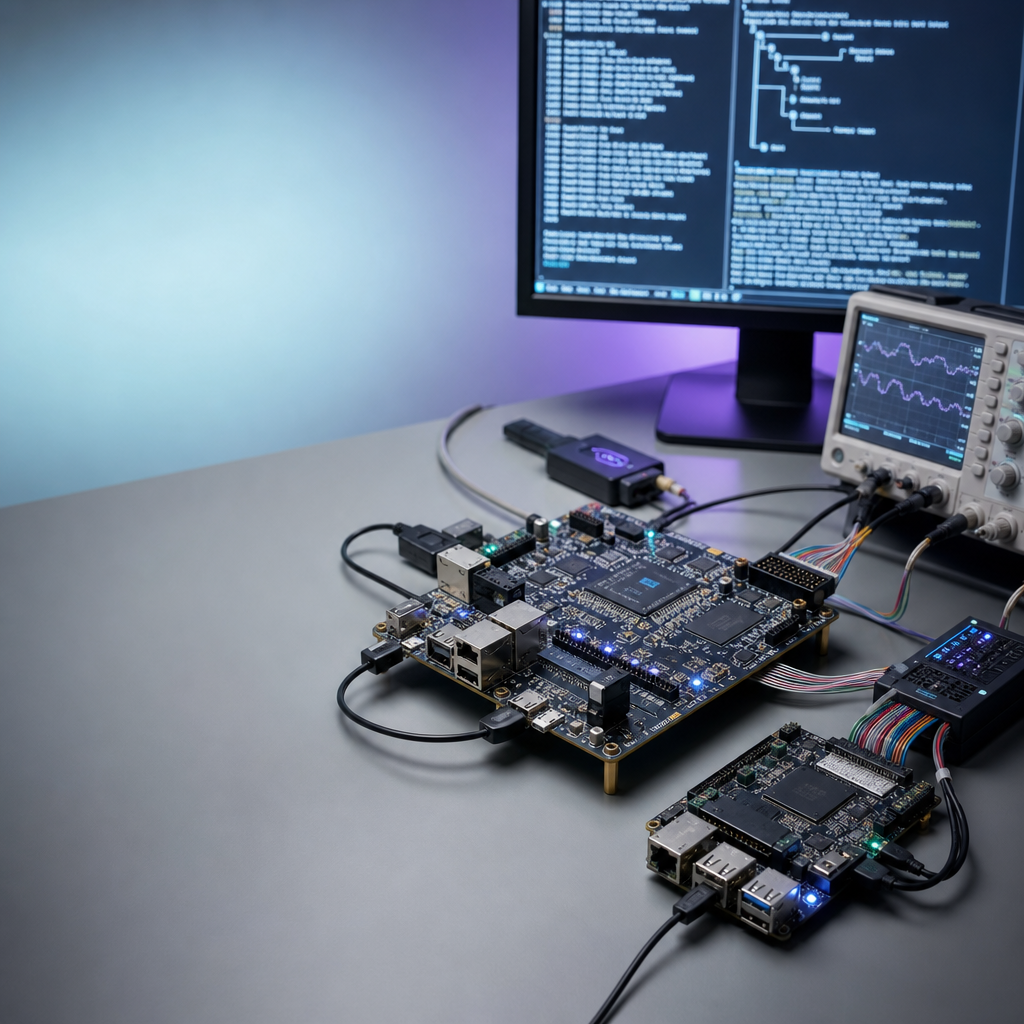
Linux embedded development board connected to JTAG, serial, oscilloscope, and logic analyzer equipment
Linux platform bring-up & driver validation

The work

Engineering that holds up beyond the demo.

We enable Linux on new platforms through board support packages, kernel configuration, driver development, distribution engineering, and system tuning. The result is a maintainable software base with clear hardware abstractions, repeatable releases, measurable performance, and the diagnostics product teams need to build, validate, and ship with confidence.

What we help you achieve

  • Quicker platform enablement
  • Hardware-aware software abstractions
  • Predictable boot and runtime performance
  • Maintainable, reproducible release branches
  • Lower driver and integration risk

Detailed capabilities

The work behind a dependable platform.

Explore the engineering areas that take this capability from a first technical decision to a stable, production-ready system.

01

Linux BSP Bring-up & Platform Enablement

End-to-end platform enablement that creates a reproducible Linux baseline for embedded products.

  • Linux enablement across product platforms and supported configurations
  • Device tree, pinctrl, clocks, regulators, interrupt routing, DMA, reserved memory, and firmware interface configuration
  • Yocto and Buildroot architecture: layers, recipes, machine configuration, package feeds, SDKs, and reproducible root filesystems
  • Boot flow integration across ROM, trusted firmware, U-Boot/UEFI, initramfs, rootfs, and application handoff
02

Device Driver Development & Integration

Kernel and user-space interfaces that expose hardware capabilities cleanly, safely, and consistently to the product stack.

  • Peripheral drivers for I2C, SPI, UART, GPIO, PWM, ADC, watchdogs, timers, and sensor interfaces
  • High-speed interfaces including PCIe, USB, Ethernet, SD/eMMC, NVMe, and storage or accelerator paths
  • Subsystem integration across networking, V4L2/media, DRM/KMS display, ALSA audio, input, thermal, regulator, and power management
  • Stable ioctl, sysfs, netlink, character-device, and user-space service contracts with clear ownership and error behavior
  • Kernel coding standards, review discipline, backport strategy, upstream readiness, and long-term maintenance planning
03

Performance Optimization & System Tuning

Evidence-driven tuning of boot time, latency, throughput, power, and thermal behavior against product-level targets.

  • Boot-time budgets, service dependency analysis, parallel initialization, startup profiling, and critical-path reduction
  • CPU scheduling, memory pressure, cache behavior, storage, networking, I/O, DMA, and interrupt-latency optimization
  • Power domains, cpufreq/devfreq, suspend/resume, thermal zones, throttling policy, and battery or energy-budget tuning
  • Profiling and bottleneck analysis using ftrace, perf, trace-cmd, eBPF, sysfs counters, and platform-specific telemetry
  • PREEMPT_RT and real-time behavior analysis where Linux must meet bounded-latency requirements
04

Debug, Stability & Production Readiness

Validation and observability practices that turn intermittent platform failures into actionable engineering evidence.

  • Kernel debugging and triage across panics, hangs, deadlocks, memory corruption, leaks, race conditions, and driver failures
  • Crash dumps, dynamic debug, printk and trace buffers, ftrace, lockdep, KASAN, KCSAN, UBSAN, and targeted instrumentation
  • Long-run, stress, suspend/resume, hotplug, fault-injection, power-cycle, and degraded-network validation
  • Support across simulated, development, and production software environments
  • Hardware-in-the-loop regression with traceable failure evidence and clear reproduction paths
05

Security, Updates & Lifecycle Engineering

Release foundations that protect the platform in the field and keep it maintainable across product generations.

  • Secure or measured boot integration, signed boot artifacts, key-handling boundaries, and trusted firmware handoff
  • Read-only filesystems, dm-verity, least-privilege services, secure device interfaces, and production hardening
  • A/B or fail-safe OTA updates, rollback protection, boot-attempt tracking, recovery environments, and update observability
  • CI pipelines for cross-compilation, static analysis, image signing, SBOM generation, license review, and reproducible builds
  • Kernel version strategy, vendor backport management, CVE response, release branches, and long-term support planning

Technical scope

Engineering detail from reset to runtime.

The work is designed around observable system behavior: what executes first, how resources are controlled, how failures are recovered, and how the platform proves it is ready.

01

BSP & distribution architecture

  • SoC and board enablement across device tree, pinctrl, clocks, regulators, interrupts, DMA, memory reservations, and firmware interfaces
  • Yocto or Buildroot layers, recipes, machine configuration, SDKs, package feeds, init systems, and reproducible root filesystem composition
  • U-Boot/UEFI, trusted firmware, initramfs, rootfs, storage layout, recovery partitions, and product handoff contracts
02

Kernel & driver stack

  • I2C, SPI, GPIO, UART, PWM, ADC, watchdog, PCIe, USB, Ethernet, storage, sensor, multimedia, display, audio, and accelerator subsystems
  • Kernel-to-user-space contracts through character devices, sysfs, ioctl, netlink, V4L2, DRM/KMS, ALSA, and network interfaces
  • Driver lifecycle ownership, upstream alignment, vendor backports, API stability, error handling, and board-revision compatibility
03

Performance & reliability

  • Boot-time budgets, scheduler behavior, interrupt latency, memory pressure, cache and DMA behavior, storage throughput, and network performance
  • ftrace, perf, trace-cmd, eBPF, lockdep, sanitizers, crash dumps, dynamic debug, hardware counters, and long-run telemetry
  • Power domains, suspend/resume, cpufreq/devfreq, thermal policy, watchdog recovery, fault injection, and hardware-in-the-loop regression
04

Security & release operations

  • Signed or measured boot, trusted handoff, key boundaries, read-only filesystems, dm-verity, service hardening, and device identity
  • A/B or fail-safe updates, rollback protection, recovery paths, boot-attempt tracking, and field diagnostics
  • Cross-build CI, static analysis, SBOM and license evidence, image signing, CVE response, reproducible builds, and release branch governance

Services and customer value

Technical work with a business reason.

Every engineering activity is tied to a decision your team needs to make: bring up faster, reduce risk, improve determinism, or prove production readiness.

01

BSP and Linux platform bring-up

Technical work

Enable Linux on target platforms by integrating boot firmware, device tree, clocks, regulators, memory, pinmux, storage, rootfs, and platform configuration.

Customer benefit

A usable and repeatable platform baseline earlier in the program, reducing the time product teams wait for hardware-aware software.

02

Kernel and device-driver engineering

Technical work

Develop, integrate, debug, and maintain drivers across standard peripherals, high-speed interfaces, sensors, networking, multimedia, display, storage, power, and accelerators.

Customer benefit

Hardware capabilities become stable product interfaces instead of one-off integrations that are difficult to test or carry across board revisions.

03

Yocto, Buildroot, and distribution engineering

Technical work

Structure layers, recipes, machine configurations, package feeds, SDKs, image composition, init services, provisioning, and reproducible release builds.

Customer benefit

Shorter release cycles, fewer environment-specific failures, and a Linux distribution the team can own and evolve after handoff.

04

Performance, power, and boot optimization

Technical work

Measure startup critical paths, scheduler and interrupt behavior, memory and I/O bottlenecks, power states, thermal limits, and real-time latency using targeted tracing and profiling.

Customer benefit

Measurable improvements in boot time, responsiveness, energy use, and thermal headroom without relying on guesswork or late-stage tuning.

05

Driver validation and platform reliability

Technical work

Build fault-injection, stress, suspend/resume, power-cycle, long-run, hardware-in-the-loop, and regression coverage with crash evidence and reproducible triage paths.

Customer benefit

Fewer field failures and faster root-cause analysis when hardware, kernel, and application behavior interact in unexpected ways.

06

Secure release and lifecycle maintenance

Technical work

Implement signed artifacts, secure boot handoff, hardened images, A/B updates, rollback and recovery, CI release gates, SBOM evidence, CVE response, and kernel backport strategy.

Customer benefit

Safer field updates, lower maintenance cost, and a platform that remains supportable across the product lifecycle.

Why this matters for AI

Intelligence needs a dependable execution layer.

AI-enabled products depend on a Linux platform that can move data efficiently, expose accelerators reliably, preserve memory and thermal budgets, and remain observable in the field. We connect kernel drivers, DMA and storage paths, camera or sensor subsystems, container or service runtime, secure updates, and performance evidence so AI workloads can move from an evaluation board to a dependable product platform.

What you take forward

Clear outputs your team can build on.

  • BSP architecture, boot-flow map, hardware/software ownership matrix, and platform dependency register
  • Device tree, kernel configuration, drivers, subsystem integrations, patches, and user-space interface documentation
  • Yocto or Buildroot layers, recipes, machine configuration, SDK, image definitions, and reproducible build instructions
  • Boot, performance, power, thermal, and real-time measurements with trace evidence and optimization recommendations
  • Validation plan, hardware-in-the-loop regression, stress results, crash triage guide, and release acceptance criteria
  • Secure update design, recovery procedures, SBOM and license evidence, CVE process, and long-term maintenance plan

Capability map

Built across the layers.

The right answer is usually a connected system of decisions, not a single isolated skill.

01

BSP and Linux distribution bring-up

02

Kernel configuration and subsystem integration

03

Device driver development and upstream alignment

04

Boot, power, thermal, and performance tuning

05

Secure update and production release foundations

06

Board-level diagnostics, debug, and validation

Keep exploring

See how the pieces connect.