
Back to Eximietas Software

Digital & Intelligence Engineering · From product idea to production system

Full-Stack Product Engineering

Build cohesive web products across frontend experiences, APIs, backend systems, data, and deployment.

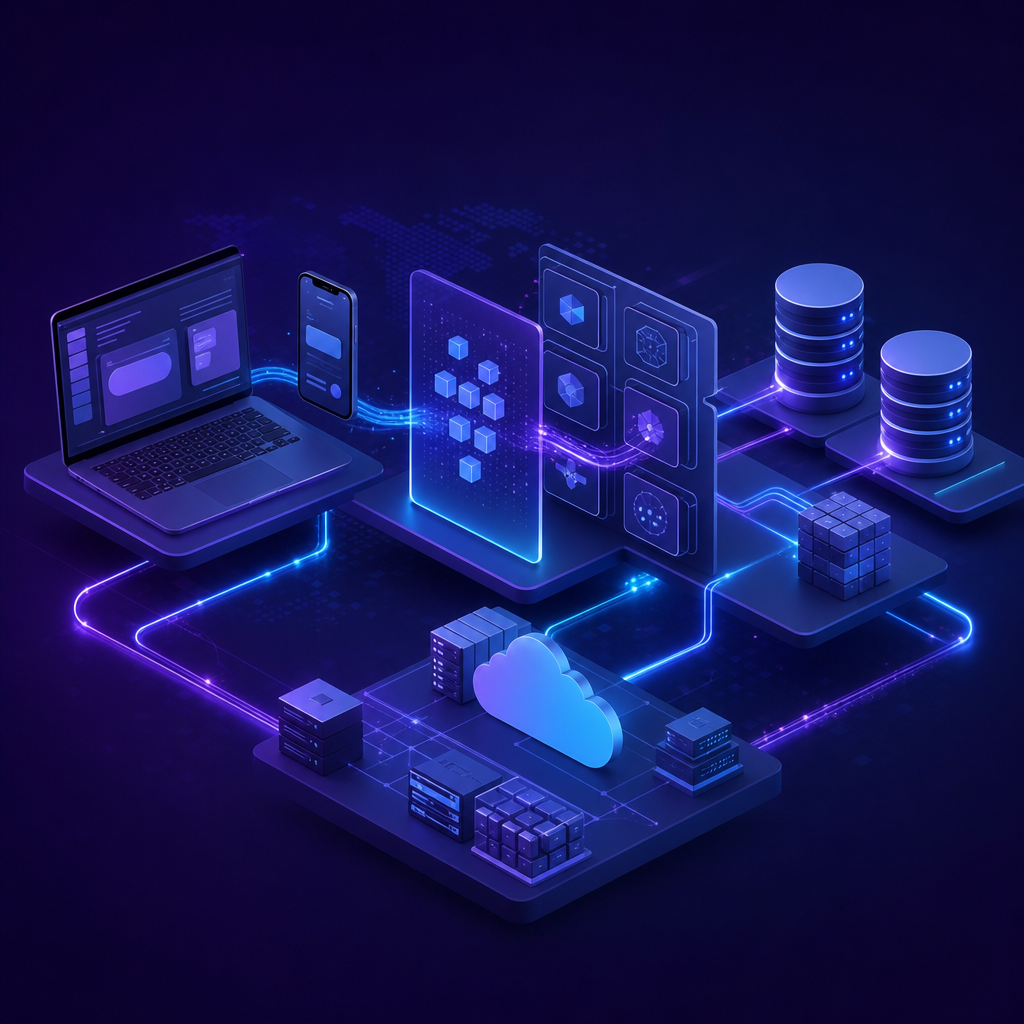
End-to-end full-stack product flow connecting frontend experience, APIs, backend services, data, and deployment
End-to-end product delivery

The work

Engineering that holds up beyond the demo.

We provide full-stack product engineering for enterprises and product companies that need a complete delivery partner across web applications, frontend platforms, backend systems, APIs, data, quality, and operations. Our teams connect user experience to the systems behind it so the result is a product that can be shipped, measured, supported, and evolved.

What we help you achieve

  • A cohesive product slice from user experience through production operations
  • Faster delivery through shared frontend, API, backend, data, and quality practices
  • More predictable product behavior with observable contracts and automated release paths
  • Reduced handoff friction between product, design, frontend, backend, data, and platform teams
  • A maintainable foundation for new features, integrations, and AI-enabled experiences

Detailed capabilities

The work behind a dependable platform.

Explore the engineering areas that take this capability from a first technical decision to a stable, production-ready system.

01

Web Applications

Create fast, accessible, responsive experiences that reflect the product’s real workflows.

  • Build responsive web applications, authenticated journeys, dashboards, forms, search, collaboration, and workflow surfaces
  • Translate design systems and product requirements into reusable, accessible frontend components
  • Connect loading, empty, error, optimistic, offline, and partial states to real backend behavior
  • Measure experience, performance, adoption, and task completion with product-aware telemetry
02

Backend Systems

Deliver the domain logic, data access, security, and operations that make the interface dependable.

  • Implement domain services, workflows, business rules, validation, persistence, jobs, and background processing
  • Design authentication, authorization, tenancy, audit, privacy, retention, and operational controls
  • Connect data stores, caches, queues, search, files, events, and external services
  • Build tests, observability, migrations, deployment, recovery, and support runbooks into the service
03

APIs & Product Integrations

Make product capabilities usable across applications, partners, internal teams, and AI workflows.

  • Design versioned REST, GraphQL, gRPC, event, webhook, and bulk interfaces
  • Define contracts, schemas, identity, permissions, rate limits, idempotency, retries, and error semantics
  • Integrate payment, identity, CRM, data, AI, communication, and partner systems
  • Provide documentation, SDKs, sandboxing, contract tests, and compatibility strategies
04

Frontend Platforms

Create reusable foundations that let multiple teams deliver consistent product experiences.

  • Establish component libraries, design tokens, routing, state, forms, data fetching, and accessibility patterns
  • Define frontend architecture, module boundaries, performance budgets, observability, and release practices
  • Support multi-brand, multi-tenant, localization, experimentation, permissions, and progressive delivery
  • Create contribution guides and quality gates that keep the platform useful as teams grow
05

End-to-End Product Delivery

Own the path from prioritized product slice to production feedback and continuous improvement.

  • Align product goals, user needs, design, architecture, implementation, validation, and release
  • Use thin vertical slices, automated quality checks, feature flags, canaries, analytics, and feedback loops
  • Coordinate frontend, backend, data, platform, security, support, and documentation readiness
  • Hand off maintainable code, runbooks, ownership, metrics, and a roadmap for the next increment

Technical scope

Engineering detail from reset to runtime.

The work is designed around observable system behavior: what executes first, how resources are controlled, how failures are recovered, and how the platform proves it is ready.

01

Web & frontend

  • Responsive applications, design systems, components, routing, state, forms, search, dashboards, accessibility, performance, localization, and experimentation
  • Loading, empty, error, optimistic, offline, partial, analytics, adoption, task, and experience states
02

Backend & data

  • Domain services, workflows, validation, persistence, jobs, background processing, authentication, authorization, tenancy, audit, privacy, and retention
  • Stores, caches, queues, search, files, events, migrations, observability, recovery, support, and deployment
03

APIs & integrations

  • REST, GraphQL, gRPC, events, webhooks, bulk interfaces, schemas, contracts, permissions, rate limits, idempotency, retries, and errors
  • Payment, identity, CRM, data, AI, communication, partner, documentation, SDK, sandbox, contract-test, and compatibility patterns
04

Delivery & operations

  • Vertical slices, quality gates, feature flags, canaries, analytics, feedback, security, support, documentation, runbooks, ownership, and release
  • Frontend, backend, data, platform, security, product, design, and operations coordination

Services and customer value

Technical work with a business reason.

Every engineering activity is tied to a decision your team needs to make: bring up faster, reduce risk, improve determinism, or prove production readiness.

01

Web application engineering

Technical work

Build responsive, accessible product surfaces with reusable components, real backend states, analytics, performance, and release controls.

Customer benefit

Users get a coherent product experience while teams gain a frontend foundation that can evolve without repeated rewrites.

02

Backend and API engineering

Technical work

Implement domain services, workflows, data access, authentication, authorization, APIs, jobs, integrations, tests, observability, and recovery.

Customer benefit

Product capabilities are dependable, secure, measurable, and ready for internal, partner, and AI consumers.

03

Frontend platform engineering

Technical work

Create design systems, state and data patterns, routing, accessibility, performance budgets, multi-tenant foundations, and contribution standards.

Customer benefit

Multiple product teams can ship consistent experiences faster with fewer quality and maintenance issues.

04

End-to-end product delivery

Technical work

Take a prioritized product slice through discovery, design, implementation, validation, release, analytics, support, and operational handoff.

Customer benefit

The organization moves from idea to measurable production learning with less cross-team handoff friction.

Fixed-bid project options

Defined scope. Measurable outcomes.

Start with a clearly bounded enterprise engineering program. Each package defines the work, outputs, assumptions, and acceptance criteria before implementation begins.

01Production pilot

Full-Stack Product Slice

Deliver one bounded user journey across frontend, API, backend, data, validation, telemetry, and deployment.

Deliverables

  • Responsive frontend flow and reusable components
  • Backend service, data model, API contract, and integration
  • Automated tests, observability, security, and release configuration
  • Runbook, documentation, metrics, and product handoff

Acceptance criteria

The agreed journey works end to end in the target environment, meets usability and quality criteria, and produces the agreed operational signals.

02Assessment

Product Engineering Assessment

Assess a defined product surface across user experience, frontend, backend, APIs, data, quality, performance, and operations.

Deliverables

  • Current-state product and technical assessment
  • Priority usability, architecture, reliability, and delivery findings
  • Target-state engineering and platform recommendations
  • Sequenced roadmap with risks, owners, and measurable outcomes

Acceptance criteria

Product and engineering owners approve the findings, target state, prioritized backlog, and delivery sequence.

03Scale & hardening

Product Scale & Operational Handoff

Harden a defined product for higher adoption, integrations, reliability, support load, and release frequency.

Deliverables

  • Performance, security, observability, and reliability improvements
  • Release, migration, rollback, support, and incident procedures
  • Capacity, cost, analytics, and product-health dashboard
  • Ownership map, runbooks, and continuous-improvement backlog

Acceptance criteria

The product meets agreed performance, reliability, security, release, support, and operational-readiness thresholds.

Why this matters for AI

Intelligence needs a dependable execution layer.

AI capabilities only become valuable when they fit naturally into a product. We connect user experience, APIs, backend workflows, data, model services, permissions, feedback, and operations so AI-enabled features feel like dependable product capabilities rather than isolated demos.

What you take forward

Clear outputs your team can build on.

  • End-to-end product slice with frontend, backend, APIs, data, integrations, authentication, validation, tests, and deployment
  • Reusable frontend and API foundations with design-system, accessibility, performance, documentation, SDK, and contract patterns
  • Production operations package with telemetry, security, release, feature flags, canaries, support, recovery, and runbooks
  • Product handoff with metrics, ownership, user feedback, roadmap, known limitations, and next-increment backlog

Capability map

Built across the layers.

The right answer is usually a connected system of decisions, not a single isolated skill.

01

Web applications, responsive experiences, design systems, and frontend platforms

02

Backend services, domain logic, data access, APIs, authentication, and authorization

03

REST, GraphQL, gRPC, event, webhook, and partner integrations

04

Testing, observability, release automation, performance, security, and reliability

05

End-to-end product discovery, delivery, modernization, and operational handoff

Keep exploring

See how the pieces connect.