
Back to Eximietas Software

Systems Engineering · Embedded software

Embedded & Firmware Engineering

Production-grade embedded software for connected products that must perform reliably in the real world.

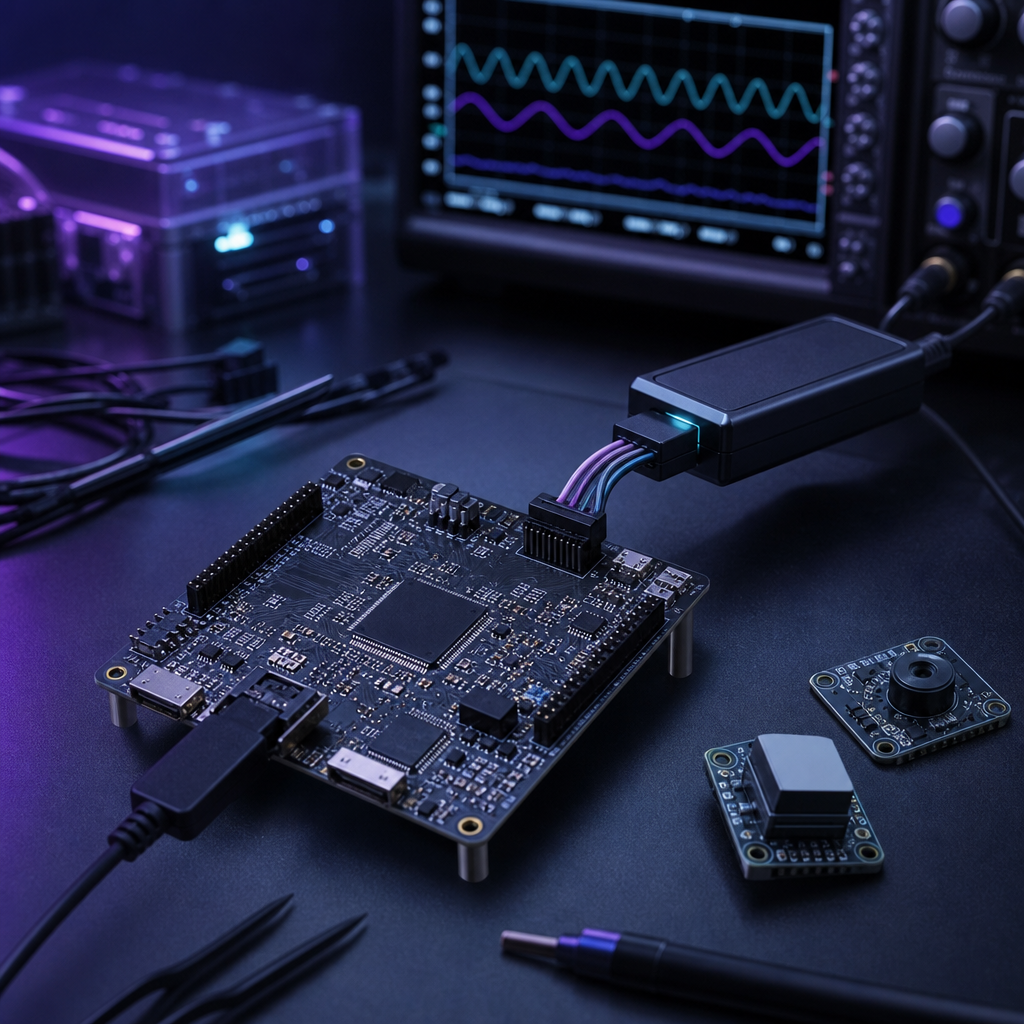
Embedded development board connected to a JTAG debugger beside an oscilloscope
Embedded platform bring-up & validation

The work

Engineering that holds up beyond the demo.

We architect, develop, integrate, and validate the embedded software stack that turns hardware into a dependable product. From boot and board support through connectivity, multimedia, edge intelligence, and production diagnostics, we connect low-level execution to the product experience.

What we help you achieve

  • Faster hardware bring-up
  • Stable product foundations
  • Predictable device behavior
  • A clear path from prototype to production

Detailed capabilities

The work behind a dependable platform.

Explore the engineering areas that take this capability from a first technical decision to a stable, production-ready system.

01

Embedded Architecture & Platform Foundations

A structured software foundation that keeps hardware dependencies isolated and product behavior predictable.

  • System partitioning across boot firmware, BSP, drivers, middleware, services, and application layers
  • Hardware abstraction layers and reusable board support components
  • Memory maps, interrupt models, DMA paths, clocks, power states, and peripheral ownership
  • Interface contracts, configuration strategy, versioning, and software architecture documentation
02

Connectivity, Sensors & Device Services

Embedded services that make connected products reliable across different networks, peripherals, and operating conditions.

  • Bluetooth, Wi-Fi, Ethernet, cellular, USB, and sensor integration
  • Protocol state machines, pairing/provisioning flows, reconnection, and offline behavior
  • Sensor acquisition, calibration, timestamping, filtering, and sensor-fusion pipelines
  • Power-aware scheduling, telemetry, diagnostics, and secure device-to-cloud handoff
03

Multimedia, Display & Data Pipelines

Performance-sensitive software for camera, display, audio, and high-throughput data movement.

  • Camera capture, display composition, audio paths, and hardware accelerator integration
  • Buffer ownership, zero-copy paths, DMA scheduling, cache coherency, and frame timing
  • Codec, format, resolution, synchronization, and resource-management decisions
  • Latency, throughput, memory bandwidth, thermal, and power optimization
04

Reliability, Security & Lifecycle Engineering

Production controls that keep devices observable, recoverable, and maintainable after deployment.

  • Secure boot, signed images, key-handling boundaries, rollback protection, and OTA update flows
  • Watchdogs, crash capture, persistent logs, health monitoring, and safe-state behavior
  • Fault injection, stress testing, race-condition analysis, and long-run stability validation
  • Continuous integration, reproducible builds, release branches, and hardware-in-the-loop testing

Technical scope

Engineering detail from reset to runtime.

The work is designed around observable system behavior: what executes first, how resources are controlled, how failures are recovered, and how the platform proves it is ready.

01

Software stack

  • C/C++ firmware, low-level drivers, middleware, and application services
  • Baremetal, FreeRTOS, ThreadX, Zephyr, embedded Linux, and custom BSP layers
  • HAL/API boundaries that allow platform revisions without rewriting the product
02

System behavior

  • Boot sequencing, initialization dependencies, interrupt routing, task priorities, and timing budgets
  • Memory allocation, DMA, cache coherency, buffer lifetimes, and resource-constrained execution
  • Power modes, thermal limits, watchdog policy, recovery paths, and field diagnostics
03

Connected device services

  • Provisioning, secure pairing, network recovery, telemetry, configuration, and remote updates
  • Sensor acquisition and calibration with timestamped, validated data paths
  • Device-to-cloud interfaces designed for intermittent connectivity and graceful offline operation
04

Validation & operations

  • Unit, integration, hardware-in-the-loop, stress, fault-injection, and long-run testing
  • JTAG, trace, logging, performance counters, crash diagnostics, and production observability
  • Reproducible builds, release gates, regression evidence, and versioned platform baselines

Services and customer value

Technical work with a business reason.

Every engineering activity is tied to a decision your team needs to make: bring up faster, reduce risk, improve determinism, or prove production readiness.

01

Embedded platform architecture

Technical work

Partition the product across boot, BSP, drivers, middleware, device services, and application code while defining stable hardware abstraction and interface boundaries.

Customer benefit

A software foundation that can absorb board revisions and new features without turning every change into a rewrite.

02

Firmware and BSP development

Technical work

Implement board support, peripheral drivers, RTOS services, Linux integration, memory and interrupt models, and the low-level control paths the product depends on.

Customer benefit

Faster hardware enablement with production-oriented code instead of throwaway prototype firmware.

03

Connectivity and device services

Technical work

Build provisioning, pairing, protocol, reconnection, telemetry, sensor, configuration, and device-to-cloud services for reliable operation in imperfect networks.

Customer benefit

Fewer field failures caused by intermittent connectivity, inconsistent sensor data, or devices that cannot recover gracefully.

04

Performance-sensitive media pipelines

Technical work

Tune camera, display, audio, codec, DMA, buffer, synchronization, memory-bandwidth, thermal, and power paths around the target hardware.

Customer benefit

Responsive user experiences and measurable performance without exceeding memory, power, or thermal budgets.

05

Embedded AI enablement

Technical work

Prepare data paths, memory movement, preprocessing, accelerator/runtime integration, scheduling, telemetry, and update mechanisms for on-device models.

Customer benefit

AI features that respond with predictable latency, operate within power limits, and remain diagnosable after deployment.

06

Reliability and release engineering

Technical work

Introduce secure update flows, watchdogs, crash capture, fault injection, hardware-in-the-loop regression, reproducible builds, and release evidence.

Customer benefit

More confident launches, safer field maintenance, and a lower total cost of ownership over the product lifecycle.

Why this matters for AI

Intelligence needs a dependable execution layer.

Embedded AI is not just a model packaged into a device. It depends on efficient data movement, deterministic scheduling, memory and accelerator integration, power-aware execution, secure updates, and telemetry that explains what happened in the field. Our embedded engineering connects those foundations so AI features can become reliable product capabilities.

What you take forward

Clear outputs your team can build on.

  • Embedded software architecture, dependency map, and hardware/software partitioning plan
  • BSP, HAL, drivers, middleware, device services, and production application components
  • Connectivity, update, diagnostics, and power-management design with implementation guidance
  • Test strategy, hardware-in-the-loop coverage, performance data, release gates, and handoff documentation

Capability map

Built across the layers.

The right answer is usually a connected system of decisions, not a single isolated skill.

01

Baremetal and RTOS firmware

02

Linux BSP, kernel, and driver integration

03

Connectivity and sensor services

04

Multimedia and display subsystems

05

Edge AI and on-device intelligence

06

Embedded software validation

Keep exploring

See how the pieces connect.