
Back to Eximietas Software

Systems Engineering · Intelligence at the edge

Edge AI & On-Device Intelligence

Useful intelligence that runs close to the data, the device, and the moment.

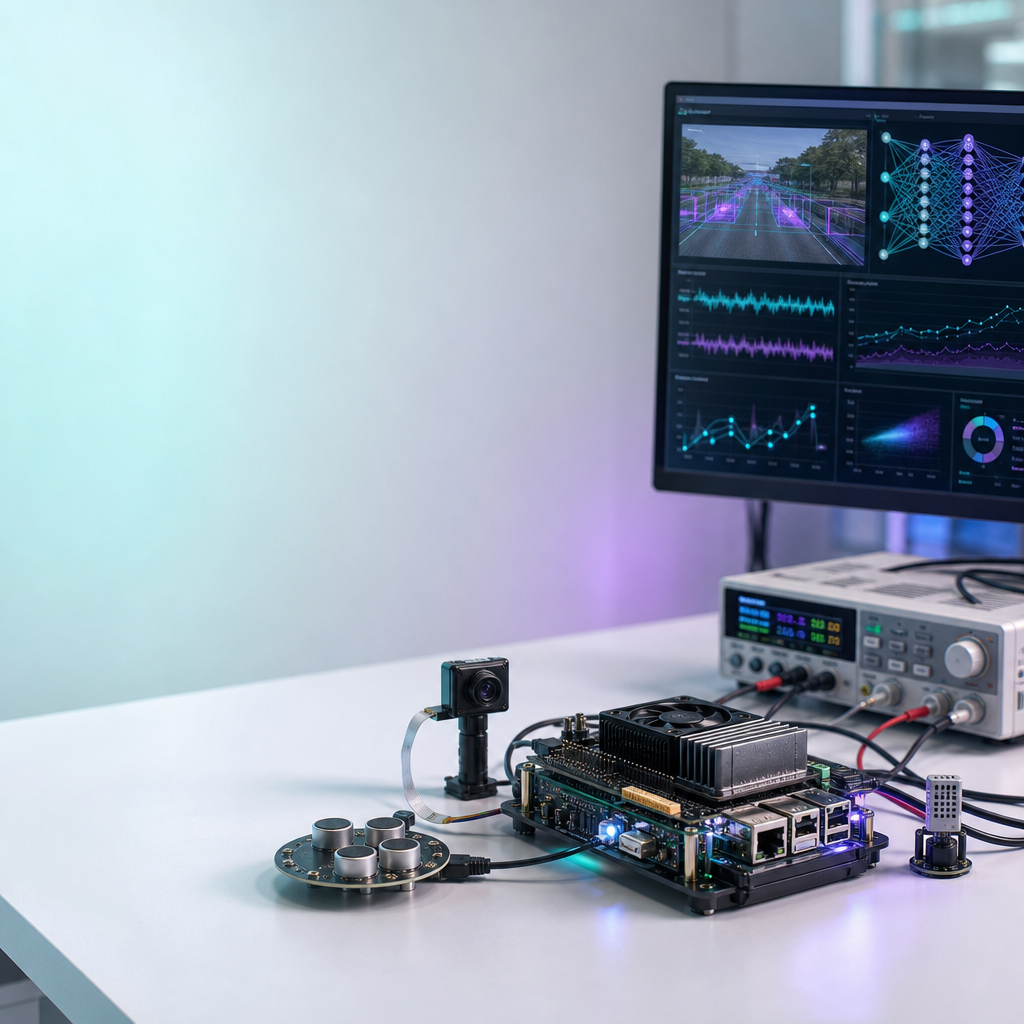
Edge AI development platform with camera, microphone, sensors, NPU accelerator, and power measurement equipment
On-device inference & edge AI optimization

The work

Engineering that holds up beyond the demo.

We take AI workloads from a trained model to a dependable product capability by aligning model architecture, device data paths, accelerator runtimes, memory, latency, power, security, and field operations. The result is responsive intelligence that can operate privately and reliably at the edge without making every interaction dependent on the cloud.

What we help you achieve

  • Lower-latency decisions
  • Reduced cloud dependency and operating cost
  • AI experiences that respect device constraints
  • Private, resilient intelligence when connectivity is limited
  • A measurable path from model evaluation to production

Detailed capabilities

The work behind a dependable platform.

Explore the engineering areas that take this capability from a first technical decision to a stable, production-ready system.

01

Edge AI Architecture & Workload Partitioning

A deployment architecture that places each part of the intelligence workflow where it can meet product, privacy, and operating constraints.

  • Partitioning across sensor, device, edge gateway, cloud, and application layers based on latency, bandwidth, privacy, and availability requirements
  • Model-serving patterns for always-on detection, event-triggered inference, streaming, batch processing, and human-in-the-loop decisions
  • Resource budgets for compute, memory, storage, bandwidth, thermal load, battery energy, and concurrent workloads
  • Fallback behavior when models, accelerators, networks, sensors, or supporting services are unavailable
  • Interfaces for model versions, feature schemas, confidence thresholds, policy controls, and application actions
02

Model Optimization & Runtime Integration

Models adapted to the target runtime instead of forcing the product to absorb an unbounded compute cost.

  • Conversion and validation across ONNX, TensorFlow Lite, OpenVINO, vendor SDKs, and device-specific inference runtimes
  • Post-training quantization, quantization-aware training handoff, pruning, operator fusion, graph optimization, and precision tradeoffs
  • CPU, GPU, NPU, DSP, and dedicated accelerator execution with delegate, kernel, memory, and fallback-path integration
  • Tensor layouts, preprocessing, postprocessing, batching, threading, asynchronous execution, and buffer reuse
  • Accuracy, latency, throughput, memory, power, and thermal comparison against a repeatable model and device baseline
03

Sensor-to-Inference Data Pipelines

Data paths engineered so models receive timely, correctly formatted, and trustworthy context from the physical world.

  • Camera, microphone, motion, environmental, industrial, and custom sensor integration with synchronized timestamps and metadata
  • Capture, buffering, denoise, resize, normalization, feature extraction, windowing, resampling, and modality alignment
  • Zero-copy or low-copy movement from sensor and media subsystems into accelerator-ready tensors
  • Quality gates for missing samples, stale frames, saturation, drift, calibration state, signal-to-noise, and out-of-distribution inputs
  • Streaming, event-triggered, and privacy-preserving preprocessing that limits unnecessary data retention or transmission
04

Performance, Power & Thermal Engineering

Production inference tuned against the real constraints of the device, not only a benchmark running in isolation.

  • End-to-end latency budgets from sensor capture through preprocessing, inference, postprocessing, and user-visible action
  • Memory footprint, tensor lifetime, DMA, cache behavior, bandwidth, accelerator utilization, queue depth, and contention analysis
  • Frequency and power policy, duty cycling, wake-on-event, batching, thermal throttling, and sustained-performance behavior
  • Concurrency across inference, media, networking, UI, storage, and background services without missed deadlines
  • Profiling with runtime traces, platform counters, ftrace, perf, vendor tools, energy measurements, and long-run workloads
05

Trust, Observability & Model Lifecycle

Controls that make edge intelligence explainable enough to operate, update, and support after deployment.

  • Confidence thresholds, calibration, abstention, fallback rules, human review paths, and safe behavior for uncertain predictions
  • Model, feature, runtime, firmware, and hardware versioning with compatibility checks and reproducible evaluation artifacts
  • On-device telemetry for latency, confidence distributions, data quality, thermal state, errors, drift signals, and accelerator health
  • Signed model packages, encrypted or protected assets, secure boot integration, staged OTA rollout, rollback, and recovery
  • Golden datasets, hardware-in-the-loop tests, regression gates, adversarial or boundary-case testing, and fleet feedback loops

Technical scope

Engineering detail from reset to runtime.

The work is designed around observable system behavior: what executes first, how resources are controlled, how failures are recovered, and how the platform proves it is ready.

01

Model & runtime engineering

  • ONNX, TensorFlow Lite, OpenVINO, vendor SDKs, graph conversion, quantization, pruning, operator fusion, delegates, and fallback paths
  • CPU, GPU, NPU, DSP, and accelerator scheduling with tensor layouts, preprocessing, postprocessing, threading, and buffer reuse
  • Accuracy, latency, throughput, memory, power, and thermal baselines that make model tradeoffs measurable on target hardware
02

Data & inference pipelines

  • Camera, microphone, motion, environmental, industrial, and custom sensor integration with synchronized timestamps and metadata
  • Capture, buffering, denoise, resize, normalization, feature extraction, windowing, resampling, modality alignment, and zero-copy handoff
  • Data-quality rules for missing samples, stale frames, drift, calibration, saturation, signal-to-noise, and out-of-distribution inputs
03

Device performance

  • End-to-end latency, tensor lifetime, DMA, cache, bandwidth, accelerator utilization, queueing, contention, and concurrent workload analysis
  • Duty cycling, wake-on-event, batching, frequency policy, thermal throttling, sustained performance, and energy-per-inference measurement
  • Runtime traces, ftrace, perf, vendor profiling, platform counters, power instrumentation, and hardware-in-the-loop workloads
04

Trust & lifecycle operations

  • Confidence calibration, abstention, fallback behavior, human review, model compatibility, reproducible evaluation, and regression evidence
  • Signed and protected model packages, secure boot integration, staged OTA rollout, rollback, recovery, and fleet version control
  • On-device telemetry for latency, confidence, data quality, thermal state, errors, drift signals, and accelerator health

Services and customer value

Technical work with a business reason.

Every engineering activity is tied to a decision your team needs to make: bring up faster, reduce risk, improve determinism, or prove production readiness.

01

Edge AI architecture and workload partitioning

Technical work

Define what runs on the sensor, device, gateway, cloud, and application layers using latency, bandwidth, privacy, availability, compute, memory, and power budgets.

Customer benefit

A practical deployment plan that avoids overbuilding the device or sending sensitive, latency-critical workloads unnecessarily to the cloud.

02

Model conversion and optimization

Technical work

Convert, quantize, prune, fuse, package, and validate models for the target CPU, GPU, NPU, DSP, or vendor inference runtime while measuring accuracy and resource tradeoffs.

Customer benefit

Smaller and faster models that fit the product’s hardware and energy envelope without making quality decisions by guesswork.

03

Accelerator and runtime integration

Technical work

Integrate delegates, kernels, memory paths, tensor layouts, asynchronous execution, fallback behavior, and runtime scheduling into the embedded platform.

Customer benefit

Higher accelerator utilization, lower inference latency, and fewer surprises when AI workloads run alongside media, networking, UI, and device services.

04

Sensor-to-inference pipelines

Technical work

Build synchronized capture, preprocessing, feature, buffering, quality, and zero-copy paths from cameras, microphones, and sensors into inference and product actions.

Customer benefit

More trustworthy predictions because models receive timely, calibrated, correctly formatted data rather than noisy or stale inputs.

05

Performance, power, and thermal optimization

Technical work

Profile end-to-end latency, memory, bandwidth, concurrency, duty cycle, energy-per-inference, thermal behavior, and sustained performance on target hardware.

Customer benefit

Responsive AI features that remain within battery, thermal, and responsiveness budgets during real sustained use.

06

AI validation and lifecycle operations

Technical work

Establish golden datasets, hardware-in-the-loop regression, confidence and drift telemetry, signed model delivery, staged OTA updates, rollback, and field diagnostics.

Customer benefit

A safer path to production with evidence for release decisions and the operational controls needed to maintain intelligence after launch.

Why this matters for AI

Intelligence needs a dependable execution layer.

This capability is the execution layer for AI-first products. Models need reliable data, efficient memory movement, accelerator-aware runtimes, thermal and power discipline, secure updates, and observability that explains performance after deployment. We connect those engineering concerns so computer vision, speech, sensor intelligence, multimodal, and generative features can operate with predictable latency, privacy, and recovery behavior at the edge.

What you take forward

Clear outputs your team can build on.

  • Edge AI architecture, workload-partitioning map, resource budgets, model/runtime compatibility matrix, and product decision record
  • Optimized model packages, conversion and quantization reports, accuracy baselines, runtime configuration, and reproducible evaluation scripts
  • Sensor-to-inference pipeline, preprocessing/postprocessing components, tensor and buffer contracts, and data-quality rules
  • Latency, throughput, memory, power, thermal, concurrency, and energy-per-inference measurements with tuning recommendations
  • Validation plan, golden datasets, hardware-in-the-loop coverage, confidence/drift telemetry, and regression acceptance criteria
  • Signed model delivery, staged OTA and rollback design, fleet version strategy, diagnostics, and long-term lifecycle handoff

Capability map

Built across the layers.

The right answer is usually a connected system of decisions, not a single isolated skill.

01

Model conversion, quantization, pruning, and runtime packaging

02

CPU, GPU, NPU, DSP, and accelerator integration

03

Sensor-to-inference and camera/audio data pipelines

04

Latency, memory, power, and thermal optimization

05

Edge observability, drift monitoring, and fleet diagnostics

06

Secure model delivery, OTA updates, and lifecycle governance

Keep exploring

See how the pieces connect.