
Back to Eximietas Software

Systems Engineering · Connected devices

Connectivity Stacks (BT/WiFi/Sensors)

The protocols, sensing, and system behavior that keep products connected.

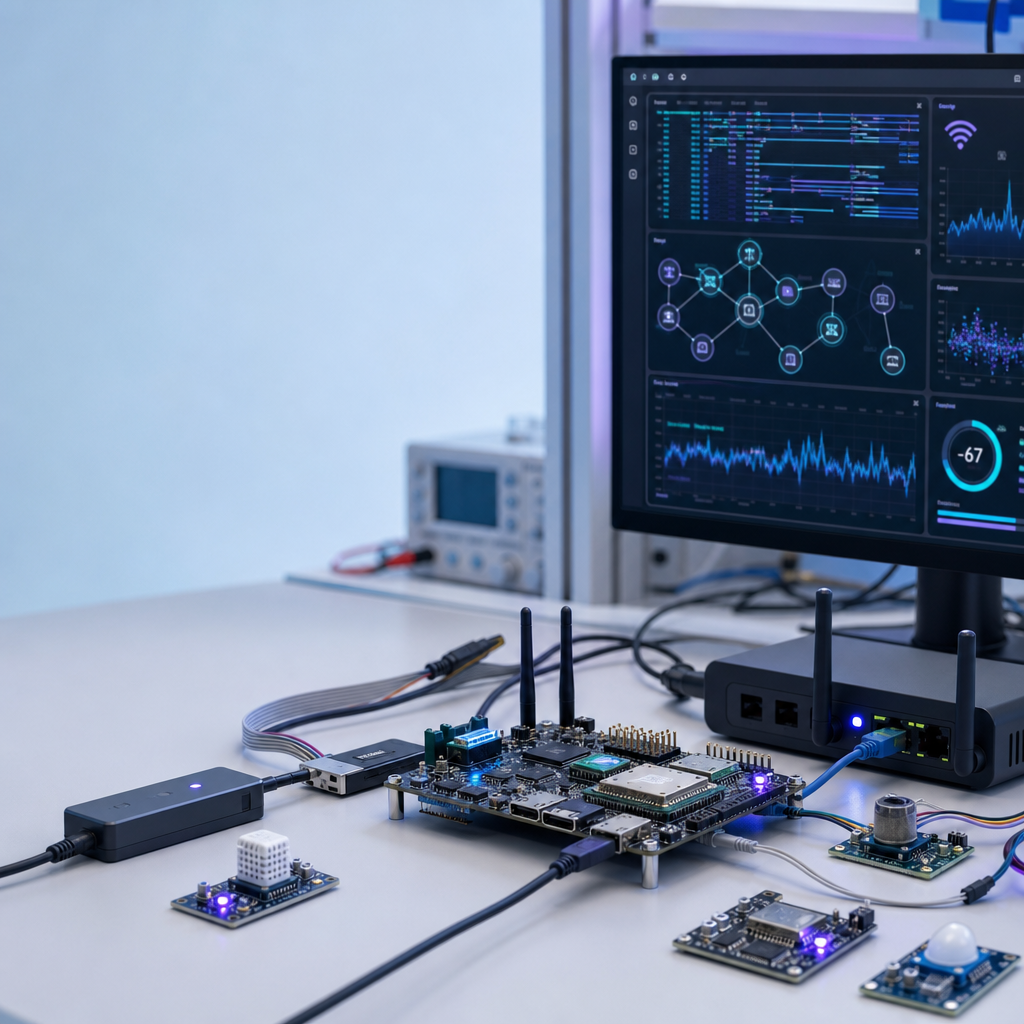
Connected embedded device with Bluetooth and Wi-Fi modules, sensors, antenna traces, and network test equipment
Wireless connectivity & sensor integration

The work

Engineering that holds up beyond the demo.

We engineer the connectivity layer as a complete system: radio and network stacks, provisioning, sensor acquisition, power behavior, security, recovery, and the application contracts above them. The result is a product that remains discoverable, responsive, interoperable, and diagnosable when real users move between networks, environments, and operating conditions.

What we help you achieve

  • Robust device interoperability
  • Faster certification readiness
  • Reliable connected experiences
  • Longer battery life without fragile connectivity
  • Higher-quality data for product intelligence

Detailed capabilities

The work behind a dependable platform.

Explore the engineering areas that take this capability from a first technical decision to a stable, production-ready system.

01

Connectivity Architecture & Device Services

A platform-level design that makes radios, sensors, networks, and product behavior work as one system.

  • Connectivity partitioning across firmware, Linux services, mobile applications, cloud endpoints, and product workflows
  • State machines for discovery, pairing, provisioning, connection, reconnection, roaming, offline operation, and factory reset
  • Device identity, capability discovery, configuration, telemetry, diagnostics, and version-compatible service contracts
  • Graceful behavior under weak signal, intermittent networks, unavailable peers, partial updates, and power transitions
02

Bluetooth & BLE Stack Engineering

Reliable short-range communication built around the product’s pairing, data, latency, and power requirements.

  • GAP, GATT, services, characteristics, notifications, indications, MTU, connection parameters, and profile integration
  • Advertising, scanning, bonding, passkey or numeric-comparison flows, privacy, and multi-device relationship management
  • Bluetooth Classic and BLE audio, HID, serial, beacon, sensor, and custom service patterns where applicable
  • Throughput, latency, range, reconnection, coexistence, and mobile interoperability testing across device families
  • Robust handling of firmware updates, key rotation, lost peers, factory reset, and user-driven re-provisioning
03

Wi-Fi, IP Networking & Provisioning

Network behavior that stays predictable across onboarding, roaming, outages, security policies, and changing infrastructure.

  • Wi-Fi station and access-point modes, scan and selection policy, WPA2/WPA3, enterprise authentication, and credential lifecycle
  • First-boot onboarding through BLE, soft AP, captive portal, QR or local interfaces, with secure handoff to production networking
  • DHCP, IPv4/IPv6, DNS, TLS, MQTT, HTTPS, mDNS, time synchronization, proxy behavior, and offline queues
  • Reconnect backoff, roaming, channel selection, keepalive policy, link-quality telemetry, and degraded-network recovery
  • Network service isolation, firewall boundaries, certificate provisioning, and device-to-cloud observability
04

Sensor Integration & Data Quality

Sensor paths designed for trustworthy measurements, useful product behavior, and future intelligence workloads.

  • I2C, SPI, UART, GPIO interrupt, USB, and vendor-interface integration for motion, environmental, optical, audio, and custom sensors
  • Calibration, compensation, timestamping, buffering, filtering, debouncing, resampling, and unit normalization
  • Sensor-fusion pipelines for orientation, activity, proximity, environmental state, and multi-modal device context
  • Data-quality checks for range, drift, saturation, missing samples, stale timestamps, disconnects, and sensor self-test
  • Power-aware sampling, batching, wake-on-event, FIFO management, and predictable handoff to local or cloud analytics
05

Power, Coexistence & Field Validation

Connectivity that performs consistently in crowded RF environments and stays within the product’s energy budget.

  • Radio duty-cycle, sleep and wake policy, connection-parameter tuning, sensor batching, and energy-per-operation measurement
  • Bluetooth/Wi-Fi coexistence, antenna and channel behavior, interference analysis, throughput, range, and latency characterization
  • RF and protocol logging, packet capture, boundary-condition testing, power-cycle recovery, and long-run connection stability
  • Interoperability matrices across phones, routers, access points, operating systems, peripherals, and firmware versions
  • Certification-readiness evidence for regional, security, protocol, and product acceptance requirements

Technical scope

Engineering detail from reset to runtime.

The work is designed around observable system behavior: what executes first, how resources are controlled, how failures are recovered, and how the platform proves it is ready.

01

Bluetooth & short-range radio

  • GAP/GATT, advertising, scanning, bonding, privacy, MTU, connection parameters, notifications, profiles, and multi-peer behavior
  • Bluetooth Classic and BLE integration across custom services, HID, audio, beacons, and sensor products
  • Pairing recovery, key lifecycle, factory reset, reconnection policy, mobile interoperability, and protocol trace analysis
02

Wi-Fi & IP connectivity

  • Station/AP modes, WPA2/WPA3, enterprise authentication, provisioning, DHCP, IPv4/IPv6, DNS, TLS, MQTT, HTTPS, and mDNS
  • Roaming, channel selection, link-quality measurement, reconnect backoff, offline queues, keepalive policy, and degraded-network handling
  • Secure credential and certificate provisioning with device identity, service isolation, firewall boundaries, and cloud handoff
03

Sensors & data pipelines

  • I2C, SPI, UART, GPIO interrupt, USB, FIFO, DMA, buffering, calibration, compensation, timestamping, filtering, and resampling
  • Sensor-fusion pipelines with range, drift, saturation, stale-data, missing-sample, and self-test validation
  • Power-aware sampling, wake-on-event, batching, data-quality telemetry, and structured handoff to edge or cloud intelligence
04

Power, RF & validation

  • Energy-per-operation measurement, duty-cycle tuning, sleep/wake behavior, connection parameters, and sensor power states
  • Bluetooth/Wi-Fi coexistence, interference, throughput, range, latency, packet capture, protocol logs, and RF characterization
  • Interoperability matrices, router and mobile coverage, long-run stability, power-cycle recovery, certification evidence, and field diagnostics

Services and customer value

Technical work with a business reason.

Every engineering activity is tied to a decision your team needs to make: bring up faster, reduce risk, improve determinism, or prove production readiness.

01

Connectivity architecture and state machines

Technical work

Define the device, mobile, cloud, and firmware contracts for discovery, pairing, provisioning, reconnect, offline behavior, telemetry, updates, and recovery.

Customer benefit

A connected experience that behaves predictably instead of accumulating fragile edge cases across firmware, apps, and cloud services.

02

Bluetooth and BLE engineering

Technical work

Implement and integrate GAP/GATT services, profiles, advertising, pairing, bonding, multi-peer behavior, throughput, latency, and mobile interoperability.

Customer benefit

Faster onboarding and more reliable device relationships across phones, peripherals, and real-world usage patterns.

03

Wi-Fi and IP network integration

Technical work

Build provisioning and network services across station/AP modes, WPA2/WPA3, enterprise auth, DHCP/IP, TLS, MQTT/HTTPS, roaming, and offline recovery.

Customer benefit

Fewer installation failures and field support issues when customers use different routers, security policies, signal conditions, and network topologies.

04

Sensor integration and fusion

Technical work

Develop sensor drivers and pipelines for acquisition, calibration, timestamping, filtering, batching, power-aware sampling, quality checks, and multi-sensor fusion.

Customer benefit

More trustworthy product behavior and higher-quality data for analytics, automation, and future AI features.

05

Power and RF coexistence optimization

Technical work

Measure energy-per-operation, tune radio duty cycles and connection parameters, analyze Bluetooth/Wi-Fi interference, and characterize range, latency, and throughput.

Customer benefit

Longer battery life and more stable performance in crowded wireless environments without sacrificing responsiveness.

06

Interoperability, certification, and field validation

Technical work

Create coverage matrices, packet and power traces, long-run tests, power-cycle recovery, degraded-network scenarios, device compatibility testing, and certification evidence.

Customer benefit

Earlier discovery of compatibility risks, faster certification readiness, and stronger evidence for a production release decision.

Why this matters for AI

Intelligence needs a dependable execution layer.

AI-enabled devices are only as useful as the data and connectivity paths beneath them. Reliable sensor timing, calibration, quality checks, buffering, secure device-to-cloud transport, and graceful offline behavior determine whether models receive trustworthy context. We engineer those foundations so edge inference and cloud intelligence can use consistent data without exhausting power budgets or failing silently in the field.

What you take forward

Clear outputs your team can build on.

  • Connectivity architecture, protocol/state-machine diagrams, device capability model, and firmware/mobile/cloud interface contracts
  • Bluetooth/BLE services, profiles, provisioning flows, pairing policy, recovery behavior, and interoperability test evidence
  • Wi-Fi/IP onboarding, credential and certificate lifecycle, network service configuration, offline queueing, and reconnect strategy
  • Sensor drivers, calibration and fusion pipeline, timestamp/data-quality rules, power-aware acquisition, and diagnostic telemetry
  • Power, RF coexistence, range, latency, throughput, and long-run measurements with optimization recommendations
  • Interoperability matrix, packet and power traces, validation results, certification-readiness checklist, and field troubleshooting guide

Capability map

Built across the layers.

The right answer is usually a connected system of decisions, not a single isolated skill.

01

Bluetooth Classic, BLE, and profile integration

02

Wi-Fi, Ethernet, IP networking, and provisioning

03

Sensor drivers, calibration, timestamping, and fusion

04

Connectivity state machines and recovery behavior

05

Power, coexistence, security, and performance tuning

06

Interoperability, certification, and field validation

Keep exploring

See how the pieces connect.