
Back to Eximietas Software

Digital & Intelligence Engineering · Delivery infrastructure

Cloud & DevOps Engineering

Cloud foundations and delivery automation that let engineering teams ship with confidence.

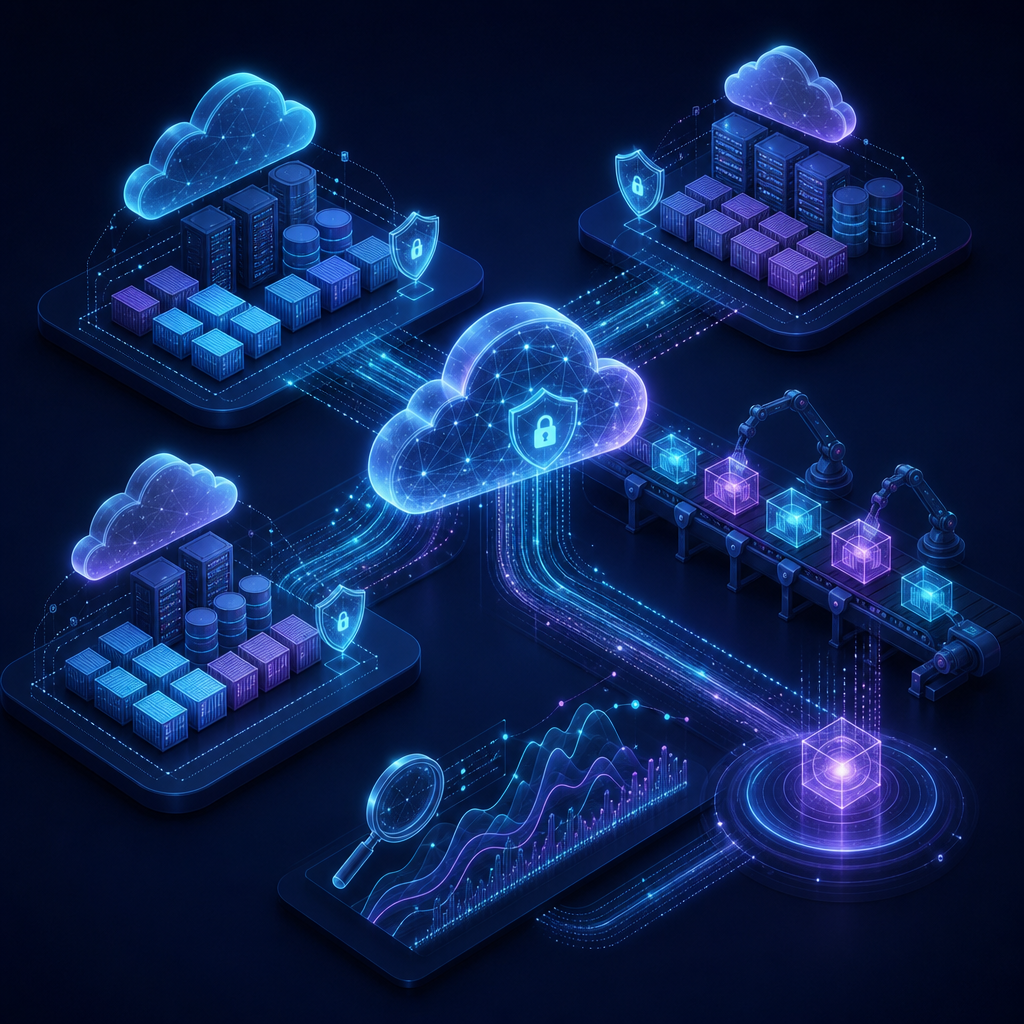
Cloud and compute infrastructure connected through an intelligent software delivery network
Cloud platform & DevOps delivery

The work

Engineering that holds up beyond the demo.

We build the operating model around modern software delivery: automated pipelines, observable services, secure environments, and infrastructure that scales with the product.

What we help you achieve

  • Repeatable deployments with less manual risk
  • Faster and safer path from commit to customer
  • Clear visibility into service health and cost
  • Cloud environments aligned to security and compliance
  • Recovery plans that are tested rather than assumed

Detailed capabilities

The work behind a dependable platform.

Explore the engineering areas that take this capability from a first technical decision to a stable, production-ready system.

01

Cloud Strategy & Foundation

Cloud adoption is an operating-model decision as much as an infrastructure decision.

  • Assess applications, dependencies, data, environments, compliance, team readiness, connectivity, and commercial constraints
  • Choose public, private, hybrid, or multi-cloud patterns around residency, latency, resilience, portability, and cost
  • Build landing zones with identity, networking, accounts/subscriptions, policy, logging, secrets, tagging, and guardrails
  • Define workload placement, migration waves, ownership, support, SLOs, and the path from project to platform
02

Infrastructure as Code & Environment Automation

Infrastructure becomes dependable when it is reviewable, repeatable, and promoted like software.

  • Codify networks, compute, storage, databases, clusters, queues, IAM, observability, and policy with reusable modules
  • Separate configuration, secrets, environment data, and application releases with safe promotion and drift detection
  • Automate provisioning, validation, previews, teardown, backup, recovery, and cost or ownership metadata
  • Create consistent development, test, staging, production, and ephemeral environments with clear boundaries
03

CI/CD & Developer Productivity

Delivery automation should shorten feedback while preserving evidence and control.

  • Build pipelines for source, tests, dependencies, containers, infrastructure, data, security, compliance, and releases
  • Use quality gates, artifact promotion, approvals, feature flags, canaries, blue/green, rollback, and change records
  • Provide build acceleration, preview environments, service templates, local parity, and self-service delivery paths
  • Measure lead time, deployment frequency, change failure rate, recovery time, flaky checks, and developer friction
04

Observability, Reliability & Security

Operations improve when teams can see behavior, understand impact, and recover deliberately.

  • Instrument logs, metrics, traces, events, health checks, dependencies, queues, cost, and user-facing transactions
  • Define SLIs, SLOs, error budgets, alert ownership, on-call practices, incident response, and post-incident learning
  • Apply least privilege, network segmentation, secrets management, image and dependency scanning, policy, and audit
  • Test failure, scaling, backup, restore, failover, and disaster-recovery paths under realistic conditions
05

Migration, Optimization & Continuity

Cloud value comes from improving the workload and the operating model, not merely changing its location.

  • Migrate through rehost, re-platform, refactor, or replace waves with dependency sequencing and rollback
  • Tune compute, storage, databases, networking, autoscaling, schedules, reservations, and architecture for cost and performance
  • Implement backup, replication, recovery objectives, multi-zone or multi-region patterns, and tested runbooks
  • Track utilization, unit economics, waste, availability, latency, throughput, and business outcomes over time

Technical scope

Engineering detail from reset to runtime.

The work is designed around observable system behavior: what executes first, how resources are controlled, how failures are recovered, and how the platform proves it is ready.

01

Cloud foundations

  • Landing zones, accounts/subscriptions, identity, networking, policy, logging, secrets, tagging, connectivity, and guardrails
  • Public, private, hybrid, and multi-cloud placement based on residency, latency, resilience, portability, and cost
  • Workload inventory, dependencies, migration waves, ownership, support, SLOs, and platform operating model
02

Infrastructure & delivery

  • Infrastructure as code for network, compute, storage, databases, clusters, queues, IAM, observability, and policy
  • CI/CD for source, tests, dependencies, containers, infrastructure, data, security, compliance, artifacts, and releases
  • Environment parity, ephemeral previews, module reuse, drift detection, promotion, approvals, canaries, and rollback
03

Reliability & security

  • Logs, metrics, traces, events, health, dependency, queue, cost, and transaction observability
  • SLIs, SLOs, error budgets, alerting, on-call, incident response, postmortems, and reliability testing
  • Least privilege, segmentation, secrets, image/dependency scanning, policy, audit, backup, restore, failover, and DR
04

Optimization & continuity

  • Rehost, re-platform, refactor, replace, dependency sequencing, cutover, coexistence, and rollback
  • Compute, storage, database, network, autoscaling, schedule, reservation, utilization, and unit-cost optimization
  • Recovery objectives, replication, multi-zone/multi-region design, tested runbooks, availability, latency, and throughput

Services and customer value

Technical work with a business reason.

Every engineering activity is tied to a decision your team needs to make: bring up faster, reduce risk, improve determinism, or prove production readiness.

01

Cloud strategy and landing zones

Technical work

Assess workloads, dependencies, residency, compliance, resilience, team readiness, and economics, then build identity, network, policy, logging, secrets, and governance foundations.

Customer benefit

Teams can move and operate workloads on a secure foundation instead of creating cloud standards project by project.

02

Infrastructure as code and environment automation

Technical work

Codify infrastructure with reusable modules, configuration boundaries, previews, provisioning, drift detection, promotion, backup, recovery, and cost metadata.

Customer benefit

Environments become repeatable and reviewable, reducing setup time and configuration drift.

03

CI/CD and developer platform engineering

Technical work

Implement pipelines, artifact promotion, quality and security gates, preview environments, service templates, feature flags, canaries, and rollback.

Customer benefit

Engineering teams ship more frequently with shorter feedback loops and stronger evidence around every change.

04

Cloud migration and optimization

Technical work

Plan and execute rehost, re-platform, refactor, or replace waves, then tune compute, storage, data, networking, autoscaling, and architecture for cost and performance.

Customer benefit

Cloud spend and performance align more closely with actual product value instead of becoming an opaque operating bill.

05

Reliability, security, and disaster recovery

Technical work

Add observability, SLOs, error budgets, incident practice, least privilege, scanning, backup, replication, failover, and tested recovery runbooks.

Customer benefit

Teams can detect problems earlier, respond with less confusion, and recover with confidence when a dependency or region fails.

Why this matters for AI

Intelligence needs a dependable execution layer.

AI workloads make cloud discipline more important: they introduce variable compute, accelerators, data movement, model-serving latency, and quality signals alongside normal service health. We build the delivery, observability, security, and cost controls that keep AI systems commercially viable and operationally trustworthy.

What you take forward

Clear outputs your team can build on.

  • Cloud assessment, workload inventory, dependency map, placement strategy, migration waves, landing-zone architecture, and operating model
  • Infrastructure-as-code package with reusable modules, environment configuration, identity, networking, policy, secrets, logging, and tagging
  • CI/CD and developer platform package with pipelines, tests, security gates, artifacts, previews, templates, approvals, canaries, and rollback
  • Observability and reliability package with logs, metrics, traces, SLIs/SLOs, alerting, dashboards, incident playbooks, and ownership
  • Optimization plan with utilization, unit economics, performance, autoscaling, reservation, storage, and architecture recommendations
  • Continuity handoff with backup, restore, replication, recovery objectives, failover tests, disaster runbooks, and support model

Capability map

Built across the layers.

The right answer is usually a connected system of decisions, not a single isolated skill.

01

Cloud strategy, migration, and landing-zone architecture

02

Infrastructure as code and environment automation

03

CI/CD, release orchestration, and developer platforms

04

Container orchestration and workload operations

05

Observability, SRE practices, and reliability engineering

06

Cloud optimization, security, and disaster recovery

Keep exploring

See how the pieces connect.