
Back to Eximietas Software

Systems Engineering · Embedded foundations

Baremetal, RTOS & Boot

From reset to runtime: foundational firmware for platform initialization.

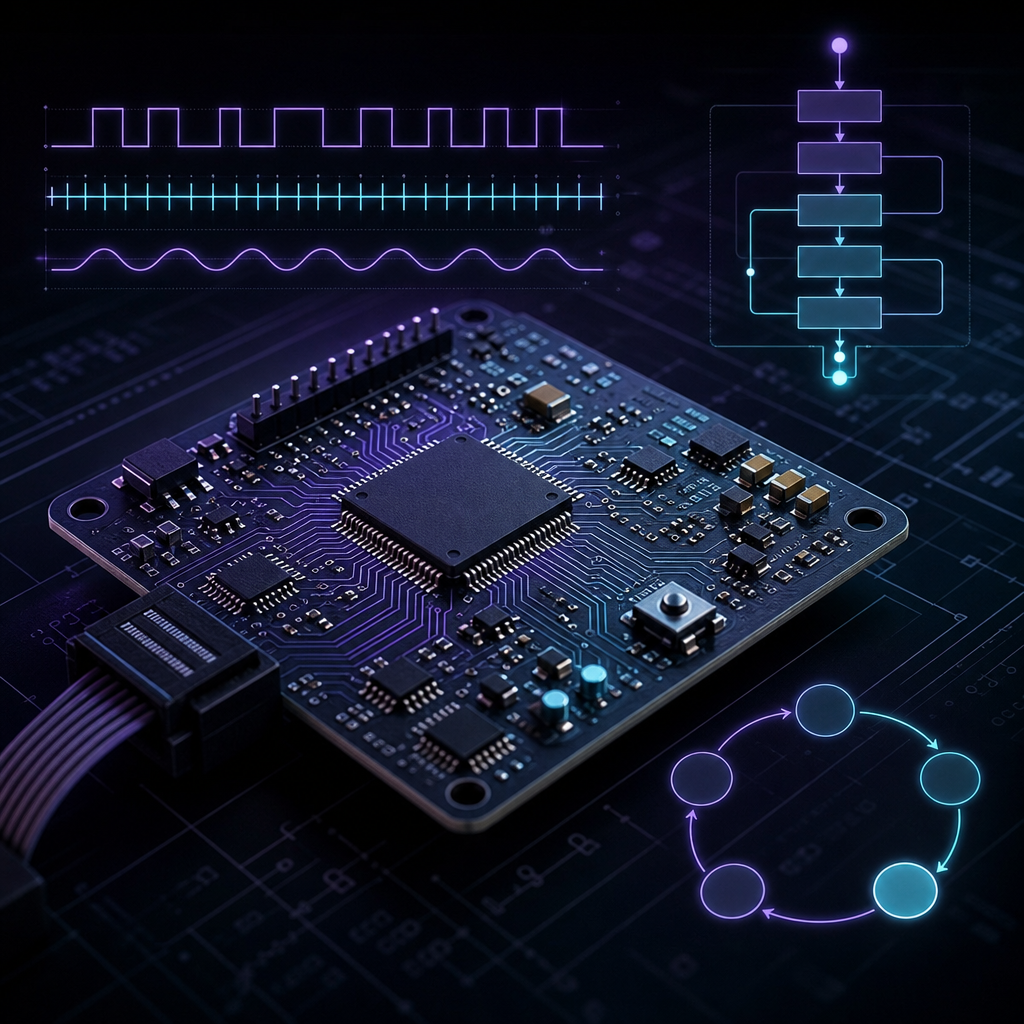
Embedded development board with timing waveforms and a boot-state flow
Deterministic boot & real-time execution

The work

Engineering that holds up beyond the demo.

We develop foundational firmware that enables platform initialization across baremetal and RTOS environments. Our expertise spans boot flows, platform initialization, and early software enablement, ensuring a stable and scalable foundation for higher software stacks.

What we help you achieve

  • Predictable boot behavior
  • Deterministic real-time performance
  • Lower bring-up risk

Detailed capabilities

The work behind a dependable platform.

Explore the engineering areas that take this capability from a first technical decision to a stable, production-ready system.

01

Boot Architecture & Platform Initialization

Design and implementation of robust boot flows from reset to OS handoff.

  • Multi-stage bootloader development (ROM, BL1/BL2, U-Boot/UEFI)
  • Platform initialization across clocks, DDR, power, and peripherals
  • Secure and non-secure boot flow design
  • Boot-time optimization and reliability
02

Baremetal Firmware & Low-Level Drivers

Development of low-level firmware for early hardware enablement and control.

  • Baremetal firmware for SoC bring-up and validation
  • Peripheral drivers for UART, SPI, I2C, GPIO, timers, and more
  • Register-level programming and hardware abstraction
  • Debug and diagnostics firmware
03

RTOS-Based System Development

Building real-time firmware systems for deterministic and resource-constrained environments.

  • RTOS integration and configuration across FreeRTOS, ThreadX, Zephyr, and similar environments
  • Task scheduling, interrupt handling, and synchronization
  • Device driver integration within RTOS frameworks
  • Performance and latency optimization
04

Bring-up, Debug & System Stabilization

Enabling early system functionality and ensuring stable operation across hardware revisions.

  • Platform bring-up and early software enablement
  • Debug using JTAG, trace, and low-level tools
  • Firmware validation and issue triaging
  • Support for simulated, development, and production software environments

Technical scope

Engineering detail from reset to runtime.

The work is designed around observable system behavior: what executes first, how resources are controlled, how failures are recovered, and how the platform proves it is ready.

01

Boot chain

  • Reset vector, ROM handoff, BL1/BL2, U-Boot or UEFI, and OS handoff
  • Clock, DDR, power-rail, pinmux, and peripheral initialization
  • Secure and non-secure paths with recovery and update behavior
02

Real-time execution

  • Interrupt latency, task scheduling, synchronization, and priority design
  • DMA, memory ownership, cache behavior, and resource constraints
  • Watchdogs, fault handling, degraded modes, and deterministic recovery
03

Bring-up & diagnostics

  • JTAG, trace, register-level inspection, and early console instrumentation
  • Platform bring-up with repeatable debug checkpoints
  • Boot-time, latency, power, and long-run stability measurements
04

Platform coverage

  • Baremetal firmware for early hardware enablement and validation
  • FreeRTOS, ThreadX, Zephyr, and comparable RTOS environments
  • Peripheral drivers for UART, SPI, I2C, GPIO, timers, and board services

Services and customer value

Technical work with a business reason.

Every engineering activity is tied to a decision your team needs to make: bring up faster, reduce risk, improve determinism, or prove production readiness.

01

Bootloader & secure startup

Technical work

Define reset-to-runtime state transitions, multi-stage boot, image selection, recovery paths, and secure/non-secure handoff across ROM, BL1/BL2, U-Boot, or UEFI.

Customer benefit

A repeatable first boot, safer field updates, and fewer platform-specific surprises during hardware and OS integration.

02

Platform bring-up & software enablement

Technical work

Initialize clocks, DDR, power, pinmux, timers, and essential peripherals while using staged checkpoints to isolate hardware, firmware, and integration faults.

Customer benefit

Shorter bring-up cycles and a clear evidence trail for isolating firmware, platform, and integration issues.

03

Baremetal drivers & hardware abstraction

Technical work

Build register-level drivers and reusable abstractions for UART, SPI, I2C, GPIO, timers, DMA, watchdogs, and board diagnostics.

Customer benefit

A maintainable foundation that can support early validation today and evolve into production firmware without throwing away bring-up work.

04

RTOS architecture & real-time optimization

Technical work

Shape task, interrupt, queue, mutex, priority, memory, and timing models for FreeRTOS, ThreadX, Zephyr, or comparable environments.

Customer benefit

Predictable latency, fewer race conditions, and a runtime that remains responsive as features and workloads grow.

05

Fault management & recovery

Technical work

Implement watchdog strategy, fault isolation, assertions, crash diagnostics, degraded modes, safe recovery, and persistent failure evidence.

Customer benefit

Systems that fail visibly and recover intentionally instead of producing intermittent field failures that are difficult to reproduce.

06

Validation & production handoff

Technical work

Combine JTAG and trace debugging with timing, boot-time, and long-run firmware validation.

Customer benefit

Confidence to move from prototype to production with measurable acceptance criteria and fewer late-stage regressions.

Why this matters for AI

Intelligence needs a dependable execution layer.

Edge AI is only as dependable as the firmware underneath it. Stable boot, predictable scheduling, efficient memory and DMA paths, and trustworthy diagnostics give on-device models the latency, power, and recovery behavior required for production.

What you take forward

Clear outputs your team can build on.

  • Boot-flow architecture, state transitions, and platform initialization plan
  • Board initialization, low-level driver, and hardware abstraction code
  • RTOS configuration, task/interrupt model, and timing assumptions
  • Diagnostics hooks, bring-up checklist, validation matrix, and performance baseline

Capability map

Built across the layers.

The right answer is usually a connected system of decisions, not a single isolated skill.

01

Bootloaders and board initialization

02

RTOS architecture and tasking

03

Memory, power, and timing optimization

04

Secure update foundations

Keep exploring

See how the pieces connect.